

The AR-15 is one of the most discussed rifle platforms in the United States, and also one of the most persistently misunderstood. Much of that confusion comes from shorthand: a name mistaken for a function, a silhouette mistaken for a capability, or a legal label mistaken for a mechanical description.

That matters because the AR-15 is not a single fixed object so much as a modular system. Receivers, calibers, operating parts, stocks, barrels, and accessories can change what the rifle does and how it handles. Treating every AR-15 as the same machine leads to bad assumptions about performance, legality, and even basic safe handling.

1. “AR” means assault rifle
The letters “AR” refer to ArmaLite, the company behind the original design lineage, not to “assault rifle” or “automatic rifle.” That point has been repeated for years, yet the mislabel persists because the platform resembles military-pattern carbines and because the initials are easy to reinterpret. In a 2018 interview, Alain Stephens explained it plainly: “A lot of people feel that, you know, the AR stands for assault rifle or automatic rifle, but, actually, it stands for Armalite.” The distinction is not cosmetic. Names shape how non-specialists talk about the rifle, and in this case the name is frequently used as if it describes what the mechanism does. It does not.

2. A civilian AR-15 fires like a machine gun
A standard civilian AR-15 is a semi-automatic rifle, meaning it fires one round per trigger press. Continuous automatic fire requires a different fire-control arrangement and additional components that are not part of a typical commercial AR-15. This is one of the most basic technical misunderstandings attached to the platform. A rifle can share an outline with a select-fire military counterpart and still work very differently at the trigger. Mechanical function, not appearance, is the meaningful dividing line.
3. Every AR-15 is basically the same rifle
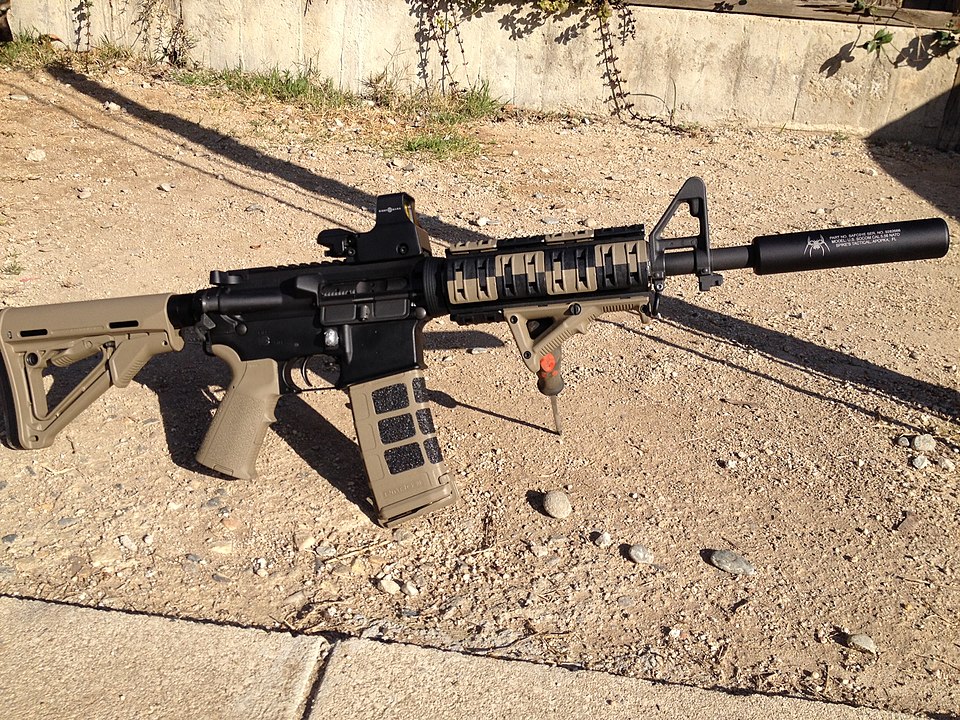
The platform’s biggest engineering advantage is modularity. The popular pairing of .223 Remington and 5.56 NATO still dominates, but the AR-15 is no longer tied to a single chambering. A practical list of SAAMI-approved AR-15 cartridges now stretches far beyond the original setup, including 6 mm ARC, 6.5 Grendel, .300 BLK, 350 Legend, and several others. That means one lower receiver can support very different roles depending on the upper, barrel, magazine, and ammunition combination. Some configurations emphasize low recoil and high-volume shooting. Others are set up for distance work, straight-wall hunting rules, or heavier bullets. Calling all AR-15s the same rifle ignores the very feature that made the platform so widespread in the first place.

4. The AR-15 is uniquely overpowered
The claim often collapses under basic ballistics. The common AR-15 chamberings .223 Remington and 5.56×45mm are intermediate cartridges, not the heavy rifle rounds many people imagine when they hear the word “rifle.” Compared with traditional full-power cartridges such as .308 Winchester, they generally produce less muzzle energy and less recoil. That lower recoil is part of why the platform is easy to control for many shooters. It also helps explain why the rifle became so common in recreational shooting and competition: controllability and repeatability are major practical advantages, and they are not the same thing as raw power.
5. Direct impingement is a flaw, and piston ARs are always better
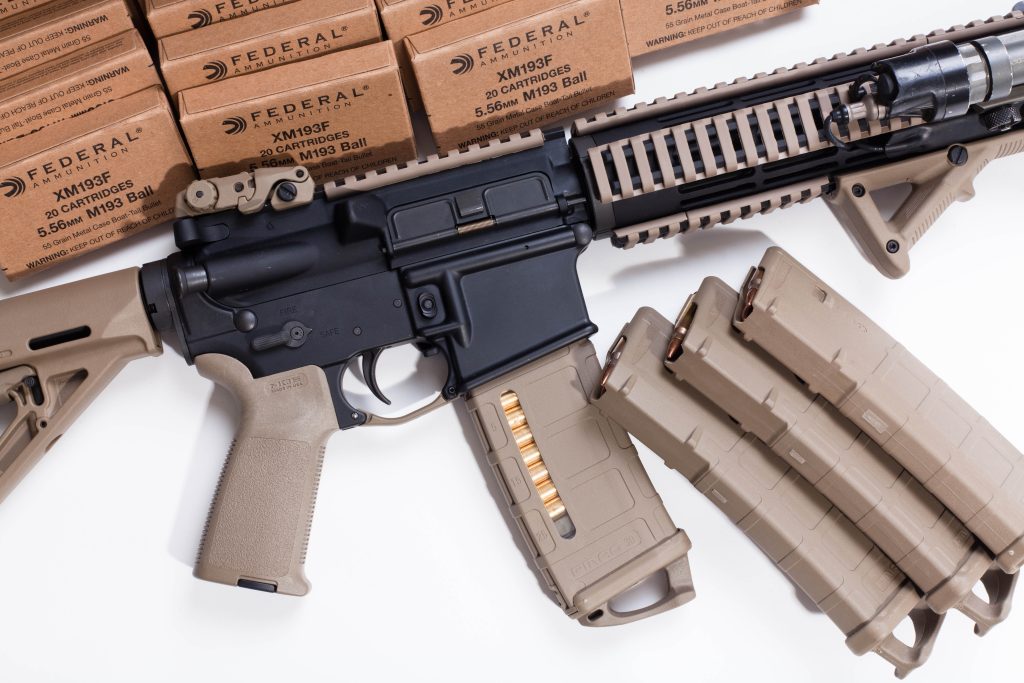
The AR-15’s operating system is often discussed as if one setup is obviously superior, but the tradeoffs are more specific than that. In a direct-impingement rifle, gas is routed through a tube back into the bolt carrier group. In a piston rifle, gas drives a separate piston assembly. Both systems work, but they emphasize different priorities. Direct impingement tends to keep the rifle lighter and is widely associated with strong accuracy and broad parts compatibility. Piston systems tend to run cleaner in the action and reduce heat on internal components, but they often add weight and can rely on more proprietary parts. The point is not that one system wins every category. It is that the AR-15 was built around a design that values efficiency, light weight, and accuracy, which is why direct impingement remains the dominant setup even after decades of alternatives. Basic operation is outlined clearly in direct impingement and piston system comparisons.

6. The platform is only useful in a military context
The military ancestry of the design is real, but the civilian platform has long been used in target shooting, competition, predator control, and hunting. That broad adoption came from ergonomics, accuracy, manageable recoil, and the ability to reconfigure the rifle for different tasks. That flexibility is why the AR-15 became so common across the commercial market. One firearms instructor quoted in a television report described it as “the choice of everybody for everything because it’s so modular,” while another called it “the Mr. Potato Head of the gun world.” The phrasing is colorful, but the point is technical: modular hardware expands utility.

7. AR pistols and braces are either always legal or always banned
Few topics on the platform create more confusion than AR-style pistols and stabilizing braces. The mistake is treating legality as a simple nationwide yes-or-no answer. In practice, the issue depends on federal definitions, court action, and separate state or local restrictions. As of 2026, the federal brace rule known as Final Rule 2021R-08F has been set aside nationwide, but that does not erase location-specific restrictions or configuration-specific legal questions. The same physical setup can be treated differently depending on jurisdiction.

For owners and builders, legal literacy matters just as much as mechanical literacy. Most AR-15 myths survive because they sound intuitive. The rifle looks like one thing, gets labeled as another, and is then discussed as if visual familiarity settled the question. It does not. The AR-15 makes more sense when treated as a machine with defined parts, defined functions, and a long record of modular evolution. Once that frame replaces slogans, the platform becomes easier to understand with far less room for folklore.


