

The AR-15 sits at the center of endless argument, but the mechanics of the rifle are far less mysterious than the rhetoric around it. Once the discussion shifts from appearance and labels to cartridge behavior, operating system design, recoil impulse, and chamber dimensions, several durable beliefs start to fall apart. That does not make the platform simple in every respect. It does make it easier to discuss with precision.

1. “AR” means assault rifle
This belief fails before ballistics even enter the picture, because it misidentifies the platform itself. The “AR” in AR-15 refers to ArmaLite, the company behind the original design lineage, not “assault rifle” or “automatic rifle.” That distinction matters because terminology shapes nearly every technical claim that follows.
The original AR-15 grew out of a lightweight rifle concept built around a small-caliber, high-velocity cartridge. In other words, the name describes a design family, not a firing mode. Once that is understood, many arguments based purely on the rifle’s military-like appearance lose their footing.

2. The civilian AR-15 is basically a machine gun
A basic look at the firing cycle defeats this claim. A civilian AR-15 is semi-automatic, meaning one round fires with each trigger pull. That is mechanically different from a fully automatic firearm, which continues firing while the trigger is held to the rear.
The confusion often survives because the platform can look similar to military rifles derived from the same family. But similar silhouette does not equal similar function. Even discussions about fast rates of fire in semi-automatic rifles usually come down to trigger speed, magazine changes, and heat, not machine-gun operation. The distinction is not cosmetic; it is built into how the rifle actually works.

3. The AR-15 is uniquely powerful
This is one of the easiest myths to puncture with cartridge math. An AR-15 chambered in 5.56 NATO or .223 Remington is not “more powerful” than another rifle firing the same cartridge. The platform does not create extra energy just because of its profile, furniture, or reputation.
What the AR-15 does often deliver is a combination of relatively light weight, controllable recoil, and useful velocity. Those traits can make it effective, but effective and uniquely powerful are not the same thing. Even reference material commonly cited in public debate notes that AR-15-style rifles are no more powerful than other hunting rifles of the same caliber. The ballistic output comes from the round and barrel setup, not the name on the lower receiver.

4. Light recoil means weak terminal performance
Basic ballistics says otherwise. The early AR-15 concept was built around a high-velocity, lightweight, small-caliber cartridge, and velocity changes what a projectile does on impact. A lighter round can still produce significant tissue disruption depending on speed, bullet construction, and what it encounters after entry.

This is where popular shorthand often goes wrong. Low recoil does not mean low effect, just as heavier recoil does not automatically mean superior real-world performance. Historical descriptions of early 5.56 performance also show that some of the dramatic wound effects once attributed to simple “tumbling” were more accurately linked to fragmentation driven by velocity and bullet construction. That is a ballistic explanation, not a slogan.
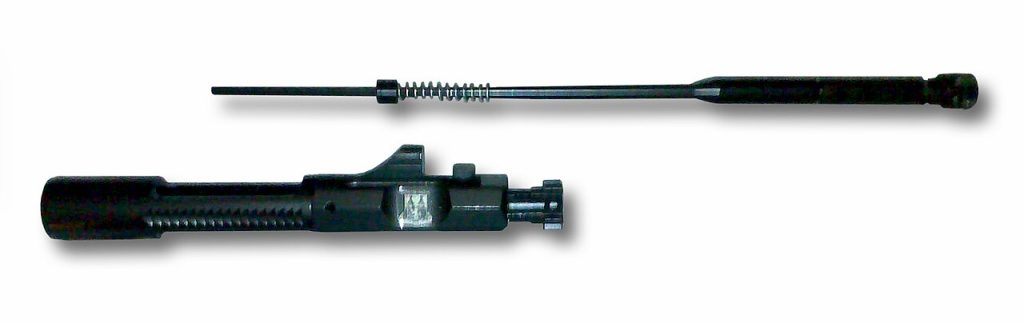
5. The AR-15’s gas system is just a crude direct-impingement blast tube
The rifle is often described in overly simplified terms, but the original Stoner system was not presented as a conventional direct-impingement arrangement. ArmaLite’s own technical language described it as “a true expanding gas system”. That distinction matters because the operating system is part of why the rifle could remain light while maintaining a straight-line layout.
That straight-line geometry is central to controllability. With recoil forces moving more directly to the rear and the stock aligned with the bore, muzzle rise is reduced compared with older layouts that drive the gun upward more aggressively. The result is not zero recoil, but a recoil pattern that is easier to manage and faster to recover from. Many assumptions about the rifle’s behavior ignore that engineering advantage.

6. Any AR-15 can shoot .223 and 5.56 interchangeably
This belief survives because the cartridges are similar, but “similar” is not the same as universal compatibility. Chamber dimensions and pressure expectations matter. A rifle chambered for 5.56 NATO can generally handle both 5.56 NATO and .223 Remington, while a rifle marked only for .223 Remington should not be assumed to safely fire 5.56 NATO.
That is not trivia. It is one of the most basic examples of why platform familiarity is not enough; chamber markings govern ammunition choices. The existence of .223 Wylde chambers, designed around broader compatibility, only reinforces the point that the issue is technical, not semantic.

7. The AR-15 is just one rifle in one caliber
This belief collapses the moment the upper receiver, barrel, bolt, and magazine ecosystem are considered together. The AR-15 became dominant in part because it is modular. That modularity is not decorative; it changes ballistic capability across hunting, target, and utility roles. Public conversation often treats “the AR-15” as if it always means one barrel length and one cartridge. In reality, the platform has been adapted to a wide range of chamberings and configurations. Even broad overviews of the category point to multiple caliber options, from .22 and .223/5.56 up through larger alternatives on AR-style systems, because the platform’s value lies in how easily it can be configured around different ballistic needs.

That flexibility is one reason instructors have described it as the “Mr. Potato Head of the gun world,” a quote used in local reporting on the rifle’s modular appeal. Most myths around the AR-15 survive by treating looks as function. Ballistics does the opposite. It asks what cartridge is being fired, at what velocity, from what chamber, through what barrel, with what recoil pattern and terminal behavior. Once the conversation stays there, the platform becomes less mythical and more mechanical. That is usually where the clearest answers are found.


