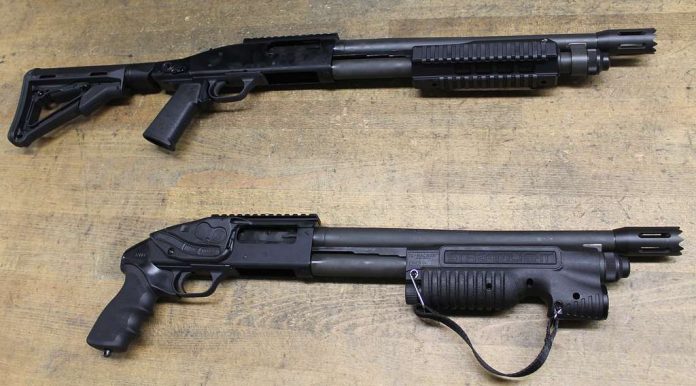

In the 590 family, Mossberg’s 2026 push isn’t about reinventing the pump gun. It is about reworking the contact points and packaging so the platform behaves more like a modern, pistol-gripped system while keeping the mechanical habits that made the 590 a default “works when it’s dirty” benchmark.
The two Chisel-branded configurations one tube-fed and one magazine-fed make that intent easy to see. The headline changes are the rotary safety, the folding stock hardware, and the way Mossberg is blending duty-grade finishes with optics-ready layouts.

1. Rotary safety controls built for pistol-grip ergonomics
The defining interface change is the ambidextrous rotary safety selector mounted where a firing-hand thumb can reach without climbing over a tang. That matters because these guns are built around AR-style pistol grips and straight-line stocks, a layout that traditionally clashes with top-mounted safeties on older Mossbergs. Both Chisel models keep the same premise: the safety is accessible from either side of the receiver and designed to be manipulated without breaking the primary grip. In practical terms, this is the control move that lets the rest of the “tactical pump” layout feel coherent rather than adapted.

2. Folding stock mount aimed at compact storage, not a gimmick
Mossberg’s collaboration adds a Chisel Machining folding stock mount to both models, turning the adjustable stock into a package that can fold along the receiver for transport and storage. The 590R Chisel and 590RM Chisel both pair that folding hardware with a Magpul MOE+ pistol grip and QD sling points for practical carry setups. Chisel’s own description of the design intent is blunt: “The folding ability is for compact storage and transport.” That frames the fold as a handling and staging feature, not a substitute for a locked-open firing configuration.

3. Two barrel lengths that signal two very different use cases
The full-size 590R Chisel runs an 18.5-inch barrel with an integrated heat shield, aligning it with the traditional “general-purpose defensive pump” footprint. The 590RM Chisel goes the other direction with an 11.5-inch barrel to prioritize maneuverability in tight environments. Both keep a top Picatinny rail for optics and a flat-profile trigger, reinforcing that Mossberg expects these to be set up with modern sighting solutions rather than treated as bead-sight throwbacks.

4. Tube-fed versus mag-fed: speed and bulk trade places
The tube-fed 590R remains the familiar load-through-the-port pump, and Mossberg highlights an enlarged, beveled loading port with an extended follower on that model. The 590RM Chisel instead centers the system on a 10-round detachable magazine, leaning into faster reload cycles and a more rifle-like manual of arms.

Mossberg’s magazine-fed approach builds on the company’s earlier work, using receiver and magazine geometry meant to keep the magazine stable under recoil. Reference testing also notes a practical reality: the double-stack magazine format brings weight and bulk, even as it shortens the time between “empty” and “back in the fight.”

5. Accu-Choke compatibility turns “tactical” barrels into tunable barrels
One of the quiet engineering wins is that select 590R/590RM variants run an Mossberg Accu-Choke system, keeping choke-tube flexibility in a category that often defaults to fixed cylinder bores. That makes pattern tuning less about swapping ammo and more about matching constriction to the job.

It also reinforces a broader point: these guns may look purpose-built for security roles, but the choke system keeps them adaptable to training, mixed loads, and pattern testing without changing barrels.

6. Finish and internal treatment focus on service life, not cosmetics
Both Chisel models are specified with a Flat Dark Earth Cerakote receiver, a coating choice typically associated with abrasion resistance and corrosion control in hard-use environments. Mossberg also calls out internal and external receiver treatment intended to improve durability and smoothness over time. On a pump gun, that attention to finish and friction surfaces is not superficial. It ties directly to long-term cycling feel, cleanup, and how well the gun shrugs off the sweat-and-grit reality of frequent handling.

Seen together, the 590R Chisel and 590RM Chisel read like Mossberg’s attempt to “square the circle” of the modern defensive pump: keep the proven 590 operating system, then repackage the controls, stock geometry, and mounting surfaces so the gun fits contemporary technique. The result is a pair of shotguns defined less by novelty than by integration folding hardware, rotary safety ergonomics, and choke/rail modularity pulling in the same direction.


