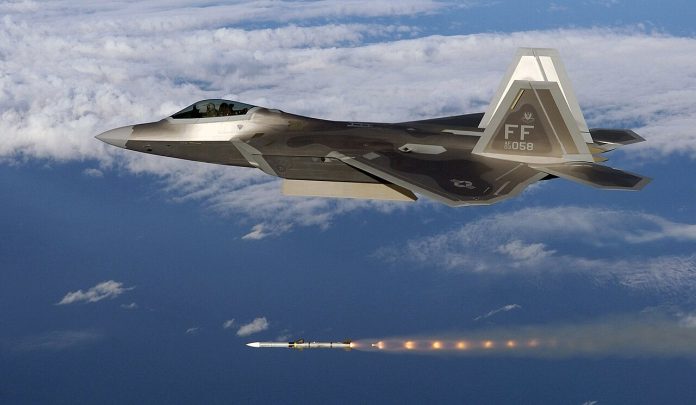
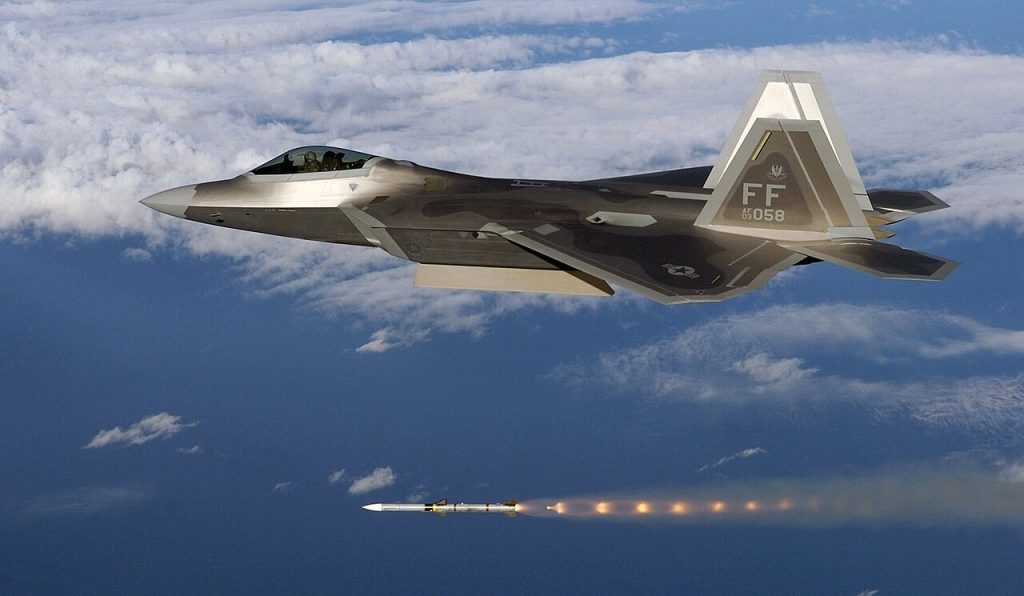
Early June 22, 2025, morning hours witnessed B-2 Spirit bombers starting the very first operational deployment of Massive Ordnance Penetrators against Iran’s Fordow and Natanz nuclear facilities. Elsewhere, another plane was working in silence to provide their safe delivery. The F-22 Raptor, being America’s finest air superiority fighter, cleared the way in leading the bombers while radar threats were muzzled and unchallenged airspace called out. Its contribution during Operation Midnight Hammer was essential, but otherwise a scarcity in the headlines a apt metaphor to a platform whose technological might has too often been overshadowed by politics, price, and the imminent arrival of its replacement.

1. A Stealth Escort in the Shadows
Operation Midnight Hammer involved over 125 aircraft, seven B-2s, a guided missile submarine launching over two dozen Tomahawks, and a full complement of ISR and electronic warfare assets. The F-22’s mission was to serve as stealth escort and airspace controller, coordinating with F-35s, F-15Es, and F-16s. Soaring high and fast prior to the strike package, Raptors conducted SEAD using AGM-88 HARM and AGM-88E AARGM missiles to neutralize Iranian radar and SAM systems. General Dan Caine attested, “Iran’s fighters did not fly, and it appears Iran’s surface-to-air missile systems did not detect us.” With this synergy of stealth, speed, and electronic warfare, the Raptor’s warfighting relevance was ensured.

2. Air Dominance Engineering
The F-22 evolved from the 1980s Advanced Tactical Fighter program to counter Soviet Su-27s and MiG-29s. The Lockheed Martin YF-22 demonstrator first flew in 1997, achieving operating status in 2005. The aircraft’s Pratt & Whitney F119-PW-100 thrust-vectoring engines provide supercruise at Mach 1.5 without afterburner, while its radar cross-section remains one of the lowest ever produced on a fighter.

With its AN/APG-77 AESA radar, sensor fusion, and outstanding maneuverability, the Raptor established the standard for fifth-generation fighters. Yet just 187 production aircraft were built well short of the initial estimate of 750 due to cost and changing priorities.

3. Combat Versatility Proven in Combat Domestically and Overseas
Other than high-end strike escort, the Raptor has been found versatile to various missions. In February 2024, it scored its initial air-to-air victories over American airspace, downing a suspected Chinese spy balloon and other high-flying targets. In the Middle East, it has helped deter regional bullies, shoot down unmanned drones, and supplement air defense in increasing Iranian-Israeli tensions. Its potential to transition from strategic deterrence to tactical interception is a design doctrine oriented toward sheer air superiority.

4. The Cost of Excellence
Raptor retirement is as much because of economics rather than obsolescence. Both are costly to maintain operational, with a small fleet size constraining logistical effectiveness. The production line shut down in 2012, locking in high sustainment costs. As one defense analyst put it, the F-22 is “the closest thing aviation history has ever had to an apex predator,” but one that the Pentagon could no longer afford to keep at peak levels.

5. Precision Strike Synergy
At Midnight Hammer, the Raptors’ screen of shielded assets enabled the B-2s to deliver 14 GBU-57 Massive Ordnance Penetrators 30,000-pound bunker-buster bombs that could penetrate hardened underground structures. These were augmented by Tomahawk cruise missiles at Isfahan, where depth below ground was higher even than the MOP’s penetration capability. The test of engineering coordination of stealth aircraft, ordnance of unusual aerodynamic design, and live SEAD operations was achieved with precision timing and minimum communications to preserve surprise.

6. The Bridge to Sixth-Generation Airpower
F-22 is to be a “bridge” to the F-47 Next Generation Air Dominance fighter, under way before 2029. NGAD is not an aircraft but a system-of-systems: manned sixth-generation fighter as the centerpiece, along with Collaborative Combat Aircraft, unmanned, high-end sensors, and adaptive-cycle engines such as Pratt & Whitney’s XA103. With open architecture for rapid overhauls, extended range, and reduced costs of sustainment, the F-47 is designed to sustain U.S. air superiority through the 2050s.

7. Technology Transfer and Legacy
The impact of the Raptor on NGAD runs deep. Stealth shaping expertise, supercruise aerodynamics, and sensor fusion expertise are being applied through digital engineering to speed up NGAD development. The F-22’s operational legacy of never having been shot down, and hardly ever seen in enemy skies, can be an actual-world performance benchmark for the next generation.

8. An Unfinished Chapter
Although the Pentagon allocated $7.8 billion for FY 2029 R&D and F-22 buys, retirement schedules will be dependent on NGAD development. If NGAD is behind schedule, the Raptor will stay around a little longer, but then it has to retire. Meanwhile, it keeps flying missions requiring the utmost stealth, speed, and killing power missions such as Midnight Hammer, where its services were required but unsung.
Raptor’s sunset years are filled with paradox: an incomparable fighter remaining in its domain, yet already poised to transfer the torch to a successor tasked with ruling an increasingly crowded future. It is still a marvel of technology its last missions a subject for study as much for what was accomplished as for what was possible.


