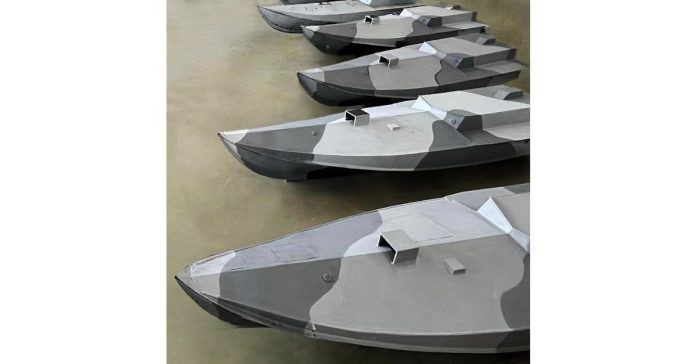
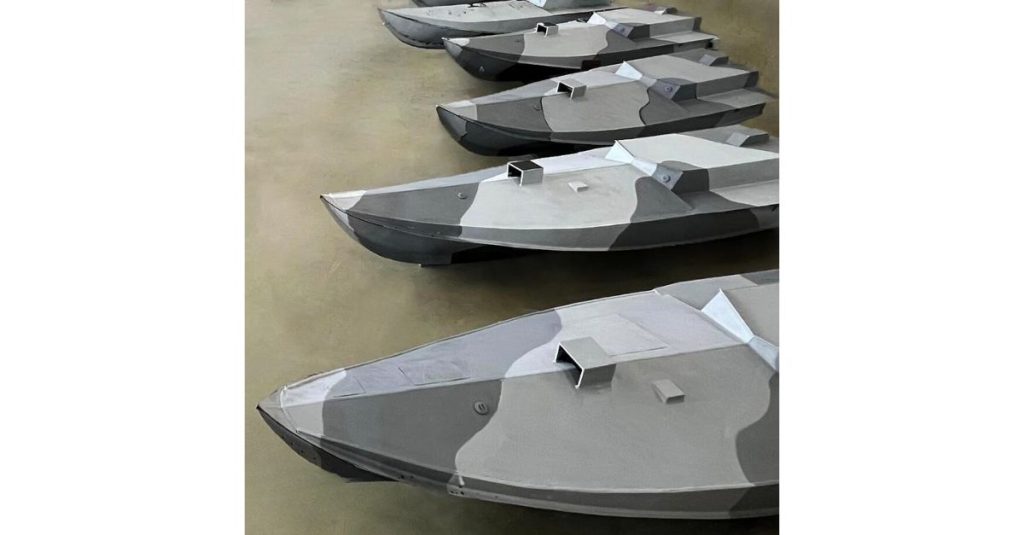
Near the end of 2025, Ukraine’s naval drones did something entirely unexpected: they moved into inland waters. For months, they had been pounding the Russian Black Sea Fleet. However, uncrewed surface crafts started hitting targets deep inside inland waterways like the Dnipro River. But this is more than simply a change of scenery-the utilization of naval drones in inland waterways means a new era in the asymmetric warfare campaign waged by Ukraine at sea.
For those of us who follow defense technology, it is an important moment to record. From ocean kamikaze attackers to riverine strike vessels, it represents both tactical responses and technological change. Introducing new target types, testing existing defenses, and speculating about future export possibilities within the NATO alliance, below are the nine key elements of the evolving Ukrainian drone warfare at sea.
1. Barracuda’s Debut in River Combat
“The Barracuda drone of the 40th Coastal Defense Brigade is Ukraine’s flagship on its inland waterways. The recent missions have been to transit from the wide river channels to small brown-water inlet attacks on Russian boats and logistical units that had been hidden behind foliage.” One of the attacks was confirmed by the Ukrainian news outlet Militarnyi to have occurred on the Dnipro River, and clearly this wasn’t in open ocean combat, as many of the earlier highly successful drone attacks at sea had been. This riverine platform gives Ukraine the capability to attack small, scattered assets “outposts, patrol vessels, and supply depots” that an “ocean” drone would not be able to reach. The success of the Barracuda also proves “the value of adapting unmanned systems to a particular environment, especially where loss of satellite communications and line-of-sight operation are required.”
2. Modular Design for Multi-Mission Flexibility
The modular design of Barracuda allows it to change weaponry within a few hours, ranging from naval mines to grenade launchers. It is capable of acting as a strike vehicle, resupply vehicle, or even an evacuation vehicle. As claimed by the brigade, “the UAV was intended to do tasks that humans cannot,” hence justifying its diverse applications. This modularity is reminiscent of their flexibility in modular design as observed in Sea Baby and Magura but with optimized capabilities in shorter range scenarios. A force multiplier in riverine battles with fleeting threats would be adaptability in reconfiguring loads without changes in design.
3. Artificial Intelligence Guidance
Even though little is known about the system, Ukraine claims that the Barracuda uses AI-assisted navigation. As GUIs in waterways are readily disrupted and manual pilots have to contend with challenging topography, AI is expected to maintain the course and perform waypoint tasks. But autonomy can’t be fulfilled without satellite communications. That is, control would necessarily have to be localized-or re-routed through sky drones-and precise attacks would be hard so far down the chain of command. The AI integration, on the other hand, offers a solution to making these maritime drones even more autonomous.
4. Inland Waterway Warfare Since Kherson
The area around the Dnipro River and the islands has been an issue since the recapture of Kherson City in November 2023. In neither area can either side initiate large-scale attacks that cross the river under constant drone coverage and artillery, so these battles are small-scale. These are where the Barracuda attacks come in the conditions are for harassment sweeps and use of mines to blockade the river. It is a local battle with strategic overtones. Ukraine can secure the liberated territories by denying movement freedom to Russia within inland waters. It means Ukraine can threaten supply lines without relying on large ships.
5. Asymmetric Economics of Naval Drones
The Ukrainian naval drones represent the cost equation, which rewrites the rules of warfare: low-cost platforms sink expensive hardware. The $50,000 USV has the capacity to target warships costing tens of millions. The war at sea has left Russia moving ships from Crimea to Novorossiysk, sitting hundreds of miles from the disputed areas. This imbalance in economies will also affect river operations. There is disproportionate disruption caused by the low-cost drone attacking an inadequately defended patrol boat or logistics hub that frees up investment in traditional sea power for the Ukrainian side.
6. Evolution of Ocean-Going Systems
Though the Barracuda has a monopoly in the terrestrial surveillance role, the ocean-based platform, ‘Sea Baby,’ is still in the development stage. An improved version by the Security Service of Ukraine has now come out with a range of 1,500 km, carrying a payload of 2,000 kg, along with the help of AI for ‘friend or foe’ identification.defense systems. These upgrades will convert single-use strike craft into multi-use platforms that will give Ukraine multiple options on the offensive front, at the same time maintaining the pressure on the Russian fleet despite the escalation of the inland war effort.
7. NATO Interest and Baltic Applications
Ukraine’s drone operations in naval fashion have piqued NATO’s interest. Task Force 66, in addition to Task Force X, have launched a series of tests regarding unmanned surface vehicles in support of data interoperability in joint operations in the Baltic Sea. In keeping with Rear Adm. Mattis’s views, “we are never going to have enough boats or assets or capabilities to do this alone,” therefore requiring “smart partnerships.” These tests included operating USVs from allied ships, scanning in advance of patrol boats, as well as maintaining distant forces-concepts of operations very much based upon Ukraine’s combat experiences.
8. The Cognitive Impact of Constant Drone Threats
In addition to physical impacts, living in a world of pervasive drone usage places a mental strain upon an adversary. It provides a sense of continuous vulnerability tending to reduce morale and compel an adversary to allocate resources to defense. So-called spider web attack techniques place a mental lock upon an adversary in a similar fashion to a physical lock. In riverine areas where terrain provides little masking of movement, so-called Barracuda drones correspondingly increase feelings of vulnerability at every shore point.
9. Export Potential and Future Doctrine
This is in addition to concerns about being physically struck by a drone attack. Barracuda threats in riverine areas similarly put a continual strain upon morale a constant fear of attack at every shore point. In shore areas where movement might be observed from a distance, these fears are, of course, multiplied. In shore areas where terrain provides little masking of movement, additional threats apply because of so-called Barracuda UAV threats, suggesting a fear of attack at every shore point. This is in addition to threats of being physically struck upon attack. It should be noted that allied nations are already looking at multi-domain intentions in regard to incorporation into doctrine regarding unmanned underwater and aerial entities as essential actors, not adjunct actors. Perhaps future doctrine should consider allowing drones to be the “organic maneuver tool.”
In regard to inland waterways, it would appear, therefore, that it would simply be a given to assign USV operations to every Coastal Defense Brigade in the same fashion as has occurred regarding assault brigades and FPV UAV operations. In any event, it would appear that Ukraine’s shift from ocean-based to inland riverine drone operations indicates a quick adaptability regarding so-called underwater aircraft clearly a rapidly developing area of warfare concerning changes in target sets and fresh environments. In summary, it would appear, therefore, regarding current developments at Dnipro, future focus upon naval drone operations in any form would be a vital asymmetric warfare tool. In regard to defense strategies, it appears quite obvious in regard to current warfare strategies regarding underwater aircraft: in current defense warfare strategies, agility, adaptability, and cost-effectiveness appear to be as effective as power itself.”


