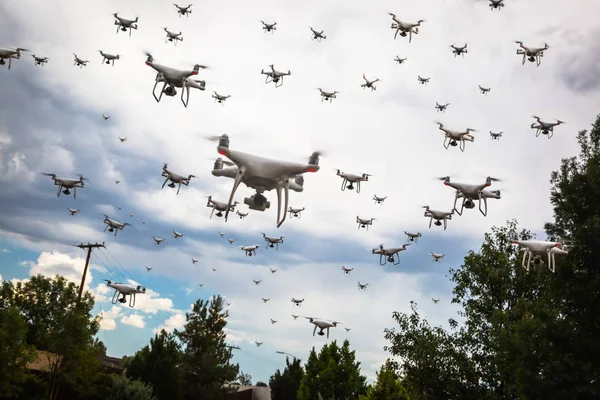
“Today, a $400 hobby drone is capable of taking out a $4 million tank.” This alone settles a century of military strategy on its head. Because, as it proves itself every day on the battlefields of Ukraine, within a conflict where the Russian side’s Massive Artillery firepower set the pacing, swarms and autonomous technologies enabled by AI are swinging the pendulum toward innovators. Ukraine has effectively become the world’s testing ground for this revolution.
From solo entrepreneurs controlling armies of drones to land robots that navigate enemy fire zones, its military tech sector is innovating at a speed that would be more characteristic of Silicon Valley. And it’s not just about Ukraine; it’s about the world, as it affects everyone from NATO and Russia to China. This list will focus on exploring the most attractive developments propelling the era of swarms, as well as technologies facilitating these developments and implications with regards to strategy that are transforming the nature of modern warfare.

1. Single Operator and Multiple Drones
A firm based in Ukraine, named Ark Robotics, is working on developing technologies that will enable a soldier to control as many as dozens or even hundreds of drones and ground robots. According to the business insider, CEO ‘Achi’ said that “the idea of running beyond that ‘drone per soldier’ paradigm is more or less a prerequisite for being successful at the overall drone warfare that will soon befall us all.” The AI will be controlling the drones and tracking the targets.

2. Autonomy of AI with Human Supervision
As seen on the battlefield, swarms are capable of identifying and locating targets, maneuvering around obstacles, and synchronizing attacks with very limited control. However, the strategy employed by Ukraine integrates human control on matters pertaining to life and death, as common among international standards and guidelines. According to reports from the Center for Strategic and International Studies, there is a very delicate focus on balancing efficiency and accountability so that no single person controls but functions as a conductor.

3. Mesh Networks for Resilient Swarms
Contemporary swarms have communications that use a mesh networking pattern and can be relayed via the drones. A detailed description of such a layout can be seen at a start-up firm named Swarmer, based in Ukraine. A disrupted network still maintains communications if a link is severed. Messages will be routed around as an interference countermeasure.

4. Countering the Jamming Threat
Thousands of drones have been destroyed every month as a result of electronic warfare on both sides. Examples among the modified drones include neural network optical navigation systems from Estonian KrattWorks, which enable drones to navigate without the use of GPS. The U.S. based Auterion droneprovider’s “terminal guidance” allows drones to target and hit an enemy before they are completely jammed, as seen with Russian jamming-equipped tanks.

5. Expanding the Kill Zone
Frontline commanders report that the deadly mission envelope now extends 6-9 miles into enemy territory. Gangs of grenade- or mine-packed FPV drones prowl for foot soldiers, armor, and fortified positions at ranges well beyond mortar and rifle fire. Frontline medics believe drones account for 60-70 percent of casualties. The effects have seen cities that were near the front lines deserted. Resupply, evacs, and mine removal are now automated.

6. Ground Robots in the Fight
Units such as the 3rd Assault Brigade use unmanned ground vehicles for logistical support, evacu- ation of casualties, and even direct fire support with automatic grenade launchers. As Commander ” Vladyka” pointed out, “even simple operations such as water delivery, ammunition transfer, evacu- ation of wounded and killed soldiers have become too hazardous for humans.” UGVs are an extension of drone warfare that envelops land and weather factors that would normally be hostile to drones.

7. Fiber Optic Drones: Russia
First introduced by Russia in 2024, these FPVs are tethered with fiber optics and are jamming proof. As long as the cord isn’t broken, these drones will remain under control. According to Yurih “Achilles” Fedorenko, a commander in Ukraine, because they are made with components provided by China, Russia enjoys superiority by a ratio of 9-1. It would be no use resisting these drones but with direct firepower.
8. AI Targeting Kits at Scale
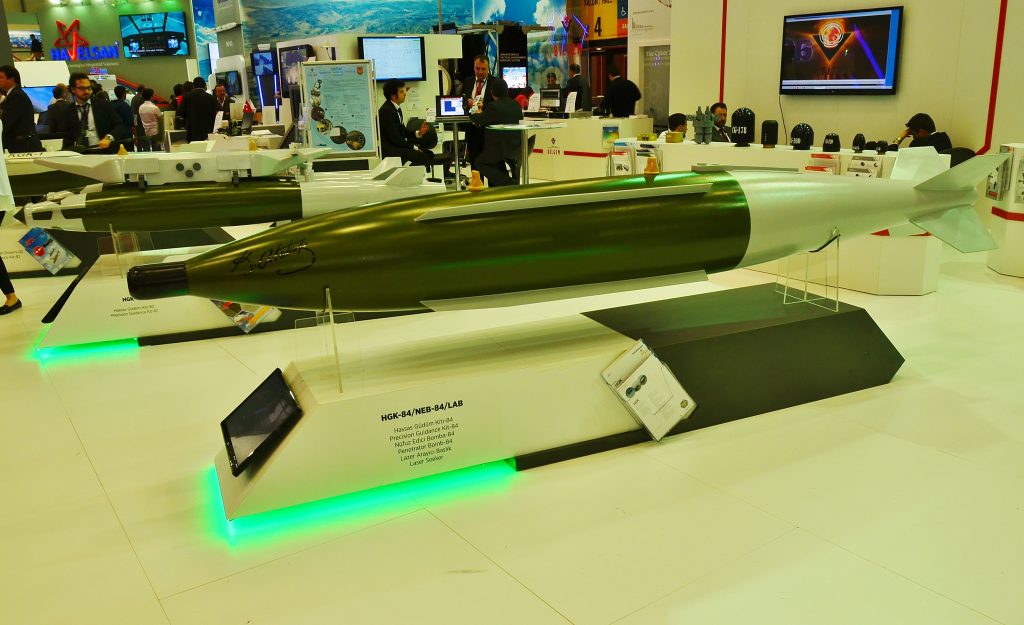
Thousands of AI-empowered ‘guidance kits’ are reaching the ranks of the Ukrainian military, enabling drones to engage either static or dynamic targets and finalize an attack even without signals. According to Auterion’s CEO Lorenz Meier, these tools make drones “a better form of artillery” because they offer precision at a mere ‘fraction of the cost.’ The targeted range within control horizons extending up to 25 miles is being explored by Ukrainian developers with ‘transmitter chains.’

9. NATOS and Global Doctrinal Changes
Members of NATO are incorporating lessons from Ukraine into swarm and counter-swarm operations. Sweden is working on technologies capable of being controlled by as many as 100 drones per soldier, while laser projects, DragonFire from the UK and high-power microwave from the US, are designed to counter drone attacks. Strategists in Russia are contemplating “digital warfare” based on swarms and computing superiority, with China enhancing its autonomous attack drones and drones for its maritime domain.
Swarm innovation within the Ukrainian forces is no mere aberration on the modern battlefield but represents a set of blueprints for what warfare will look like in the future. The intersection of AI autonomy, hard communications, and air-ground robotics will fundamentally alter force structure and strategy. The dilemma for armed forces around the world is this: equalize scale and adaptability, and develop a solution before anyone else. Within a swarm scenario, it will be necessary for forces to adapt at a quicker rate than their opponents if they are to set proper terms on the battlefield.


