A distant, reddish flash from the very boundary of time has chalked up something unexpected in the record books. A supernova associated with GRB 250314A at a redshift of 7.3 exploded just 720 million years after the Big Bang, or about five percent as old as the Universe is today. That marks it firmly within the Epoch of Reionization, a very significant period in which the first stars and galaxies began to make the Universe from transparent to opaque.
1. Discovery Without Gravitational Lensing
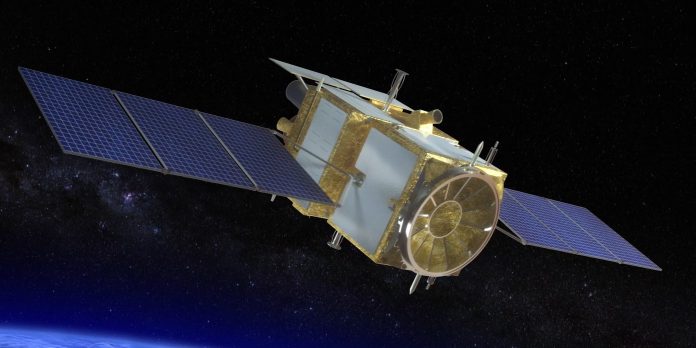
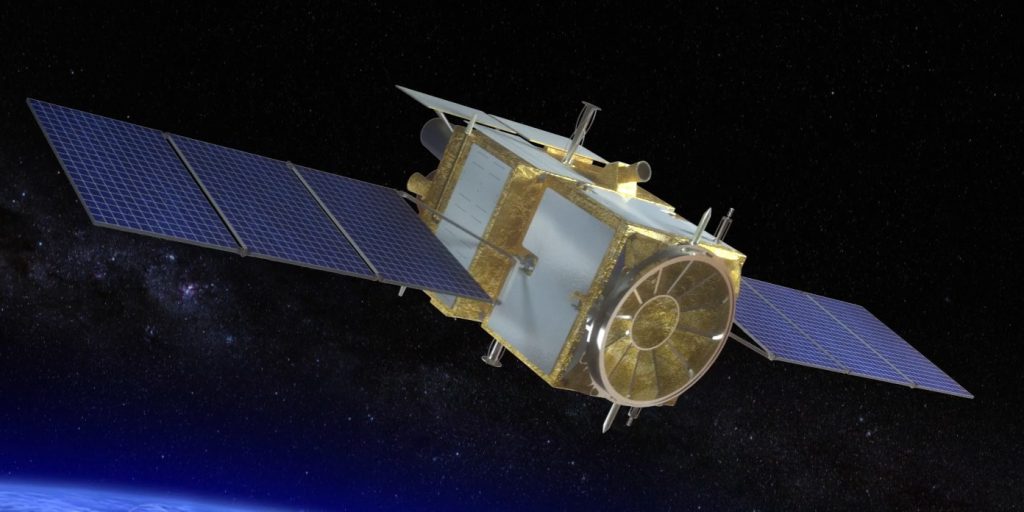
At these distances, most supernovae have been discovered only after being made visible through gravitational lensing. In this instance, the observation was made without any amplification by the James Webb Space Telescope. The observation began with the Franco-Chinese Space Variable Objects Monitor mission, intended for gamma-ray burst detection. A single pulse burst lasting 11 seconds within 8-50 keV with an approximate rest frame peak energy of 642 keV and isotropic equivalent energy 4.65 x 10^52 ergs took place on March 14th, 2025. The observation was followed up with Swift, Nordic Optical Telescope, and Very Large Telescope observations.

2. Connecting GRB with Supernova
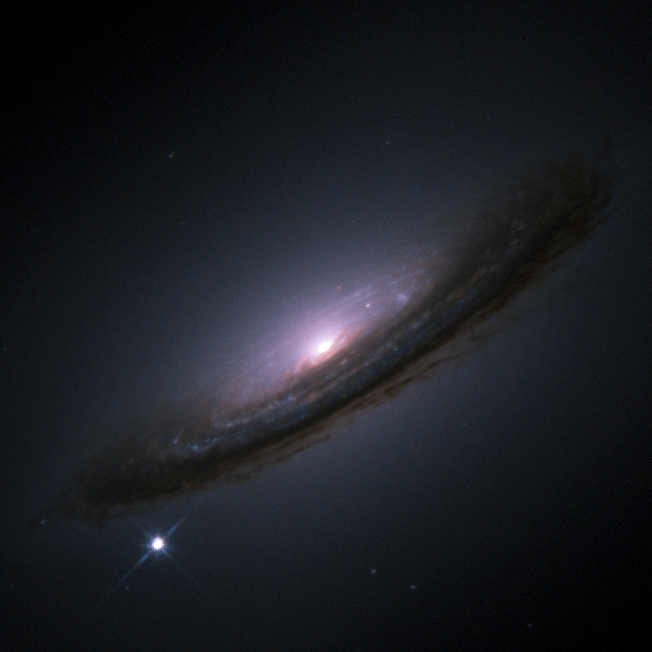
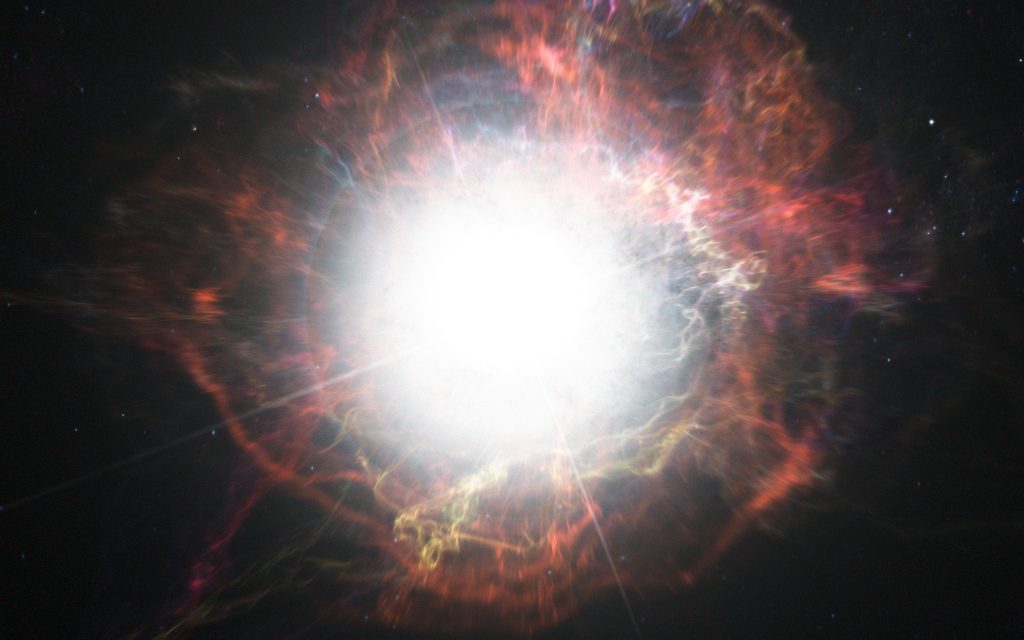
The long GRBs are associated with core collapse supernovae of massive stars. The gamma flash signals the formation of either a black hole or a neutron star, and then there is the optical/infrared peak of the supernova. At z = 7.3, the cosmic expansion caused protraction of the light curve–cosmic time dilation made the supernova increase brightness with months instead of weeks. After 3.5 months, JWST planned observation, as it corresponds to the peak brightness.

3. JWST’s Infrared
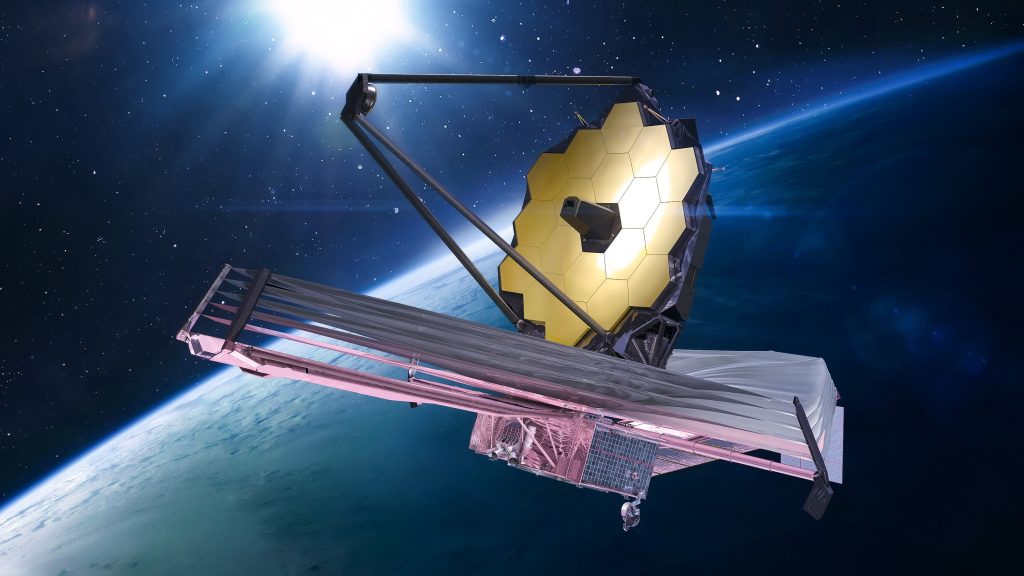
The host galaxy and the supernova were observed with NIRCam on JWST with eight filters ranging from 1-5 microns. It was detected only beyond F150W2, with a flat spectrum until F277W, and a steep increase toward F444W. The absolute peak magnitude, MB ≈ -19.41, very closely resembled that of the well-known and extremely well-observed Supernova 1998bw, a standard reference for Broad-lined Ic Supernovae associated with GRBs.
4. Similarity with Modern Supernovae
There were also some differences expected in early universe supernovae due to low metallicity and different routes of stellar evolution. However, as Nial Tanvir pointed out, “The Webb observations have shown that ‘this supernova looked no different from modern supernovae.’” The spectral energy distribution eliminated superluminous and blue supernovae and indicated that deaths of massive stars during reionization might be very similar.

5. Host Galaxy Properties
The host galaxy itself shows up as an LBM-like, slightly extended, and very distant galaxy with an MUV magnitude of approximately -17.8. This is as expected for an extremely distant GRB host, which would be relatively small, low-luminosity, and highly active. It was possible to distinguish it from the transient due to the resolution offered by JWST.

6. Implications for Epoch of Reionization
The Epoch of Reionization lasted approximately 380,000-1 billion years after the Big Bang and witnessed ionization caused by ultraviolet radiation from the first stars on neutral hydrogen. Cases such as these offer direct insights into specific stars active at these times. The analogy with nearby supernovae regions implies there might have been similar evolutionary and explosion phases among some massive stars at these early times and can be used as knowledge for generating ionizing photons and developing galaxies.
7. Technical Challenges and Follow-Up Strategy
Afterglows for high-Z GRBs occur quickly and thus demand rapid, multi-wavelength follow-up observation. The rapid slewing times (<2 minutes) and collaboration with ground-based NIR spectrographs were instrumental for SVOM. The initial deep constraints on the optical afterglow made it appear as though it had a high redshift. Follow-up spectroscopy with VLT revealed a Ly-α break at 10090 Å. Upcoming missions, SOXS and CAGIRE, will improve follow-up opportunities within the NIR.
8. Cosmic Time Dilation in Action
The extendend light curve illustrates the effect of cosmological time dilation, for which timing is proportional to (1+z). At z = 7.3, the 13-day peak would have been 110 days after the burst. This agrees with precision measurements from type Ia supernovae and confirms the expanding universe model.

9. Simulation Context
Simulations on large scales, as seen with Cosmic Dawn III, simulate the process of reionization with trillions of particles, illustrating an approximate heating and suppression of star formation due to ionizing photon emission from galaxies. The direct detection of supernovae at these timescales serves as a precious constraint on models. The accuracy of JWST data and modeling before observation highlights its capabilities for exploring the individual deaths of stars within the early Universe. As more GRBs are discovered, it becomes possible to confirm if there has been consistency among these associated supernovae over 13 billion years.


