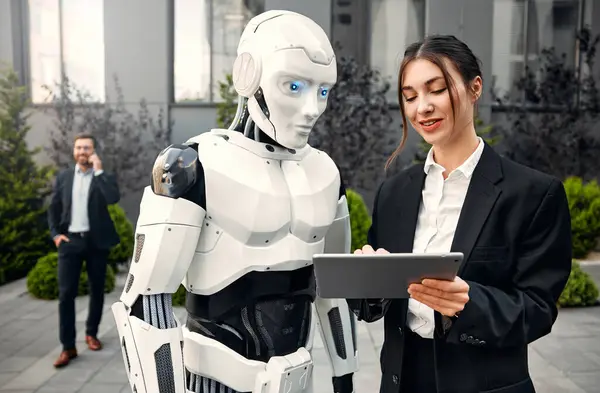
The rate of adoption is unparalleled: “It’s a three-year-old technology and it’s been adopted at a rate that’s unmatched in modern history,” said OpenAI CEO Sam Altman. Since its introduction late last year, generative AI tools have gone from being an indulgence to a necessity and have seamlessly integrated into various operations like finance, software development, customer service, and more. Altman worries about the rate at which society might be unable to adapt.

1. Acceleration beyond Historical Precedent
Altman pointed out that there isn’t any other technology that achieved this scale at such a rapid rate. The current models will provide ‘gold standard performance’ on problems previously considered beyond humans, and it would cost more than an order of magnitude per unit of intelligence. It would take dollars and months for an engineer with high expertise, but it can be achieved in minutes at an expenditure comparable to a dollar.

2. Competitive Pressure in Big Tech
The AI arms race is escalating among Alphabet, Meta, Anthropic, and OpenAI. Early adopters among enterprises, and finance specifically, are applying AI to mission-critical operations. Morgan Stanley and Bank of New York have incorporated AI into mission-critical operations and thus indicate that “AI company” will no longer be applicable as intelligence will be a standard attribute for all services and products.

3. Labor Market Instability
Goldman Sachs researchers project that as many as 6-7% of U.S. jobs will be potentially displaced due to AI adoption, and frictional unemployment will increase by 0.5 percentage points as a result.Jobs at risk due to displacement because of high task repetition and low error tolerance include programmers, accountants, legal assistants, customer service representatives, and telemarketers. Hiring for entry-level “AI-exposed” occupations has already fallen 13% due to large language models.

4. Diverging Views on the Future of AI
Google CEO Sundar Pichai’s vision for AI is as a user agent that can undertake intricate business tasks, and Geoffrey Hinton’s fear for AI implications is “massive unemployment” that makes a few rich and many poorer. Hinton’s criticism focuses on the capitalistic system and describes universal basic income as ineffective with regard to addressing work as a source of dignity. Altman uses UBI trials as a safety net against disruption, and Elon Musk forecasts a “benign AI future” with no jobs but everyone receiving income.

5. Modeling Economic Systems and Historical Lessons
Goldman Sachs points out that 60% of today’s jobs in the U.S. labour market were not existent as of 1940, implying that job creation due to technological advancements has always overtaken job destruction. Nevertheless, it appears that the transition associated with AI might be more immediate and thus amplify short-term unemployment. Previous instances of automation, be it automated tellers and internet booking, have shown an ultimate increase in productivity and jobs.
6. Industry-Focused
The impact posed on the labor force by AI hasn’t been a secret among business leaders. Ford Motor Co. CEO Jim Farley forecasted that “literally half of all white-collar jobs” would be automated. Salesforce reduced customer service staff from 9,000 to 5,000, and Klarna reduced 40% staffing after applying AI. Moreover, research among car salespersons shows that AI would be capable of selling cars automatically from 2027, ranging from promotional assets to finances.

7. Technical Risks and the Need for Stronger Governance
Altman identifies three types of risk: malicious superintelligence utilization, loss-of-control incidents, and societal overdependence causing loss of control. AI has already “fully defeated most of the ways that people authenticate currently other than passwords,” and it becomes necessary to move beyond voice and image authentication. The technologies’ need for authentication and verification will drive innovation and become more complex as they develop more capabilities for synthetically fraudulent and impersonating activities.

8. Productivity Gains and Output Scaling
Productivity gains are being realized with generative AI, with scientists doubling and tripling productivity and programmers seeing a tenfold increase. Historian Altman forecasted an “intelligence too cheap to meter” impact on labor productivity, which could increase labor productivity in developed markets by as much as 15%, once fully deployed. Competitive advantage will accrue to those who integrate it fastest into core operations.

9. Uneven Global Impact
Emerging markets offer an arena where AI may serve as an equalizer. According to Altman, emerging markets rely on professionals. However, he uses an apt metaphor here, saying, “In places with no professionals, ‘the alternative to a ChatGPT doctor is not a real doctor, it’s nothing at all.” AI finds itself on the frontlines as a disruptor within more mature markets and as a service enabler within emerging markets. As the integrate continues, so does the gap emerging on either side of reaction toward AI. The next generation will be determined on whether governments, businesses, and employees have progress on an accelerated scale that keeps up with rapid technological progress.


