
An antitail, where the tail of a comet turns back on itself, slicing back towards the Sun, occurs in defiance of expectations—and was exactly what NASA found on the interstellar comet 3I/ATLAS in November 2025. In this antitail, there was a defined jet of dust and ions extending towards the Sun, fading in only forty-eight hours, with a conventional ion tail that was over 56,000 kilometers. Such rapid activity on the comet’s tail led to much confusion, with explanations being associated with unusual interactions between positively-charged particles and the magnetic field of the solar system, something that has never been witnessed before.

1. Hyperbolic Trajectory and Interstellar Origin
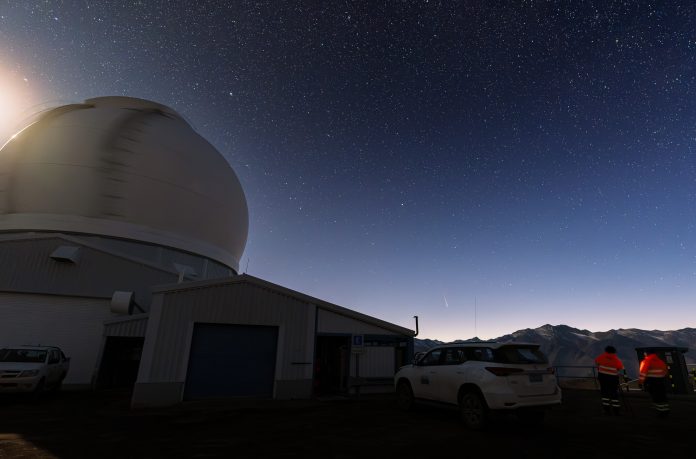
Discovered onJuly 1, 2025, inChile, by the ATLAS telescope, the comet3I/ATLAS would soon be found touse a hyperbolic orbit, its speed of 58km/s being sufficient enough that its orbit would never be bound by the gravity of the Sun. Estimates show that this comet might have wandered through the galaxy for millions of years prior to its being attracted within our Solar System. Coming as close as270 million kilometersto our planet, its path would alsopassjust50 million kilometers from the planet Jupiter in March of2026.

2. Jupiter’s Hill Radius Encounter
Computations suggest that the closest approach, or 53.445 million kilometers with an error bar of 0.06 million kilometers, exactly reflects the Hill radius of Jupiter, which is 53.502 million kilometers, beyond which the gravitational pull of Jupiter overwhelms that of the Sun. This is so precise that this was labelled “a coincidence with one part in 26,000” by Avi Loeb. This magnitude of non-gravitational acceleration, as the comet approached perihelion, of5×10⁻⁷AU/day², was enough to achieve this entry along the boundary. If this proposal gets through, NASA may alter the course of its Juno spacecraft to intercept this comet.

3. Exotic Chemical Signatures
By analyzing the comet’s coma using the James Webb Space Telescope Very Large Telescope’s spectroscopy, its composition was identified as composed mostly of carbon dioxide, with a percentage composition of 95% carbon dioxide and only 5% water, with trace amounts of cyanides and carbon monoxide. However, the most intriguing aspect is that the nickel vapor composition is lacking iron, with a composition that doesn’t appear in any natural comet. Back on Earth, this is done as a nickel carbonyl process, with the expertise being focused on producing high alloy metals. Also, taking note is that the intensity of nickel, with a rate of 5g/s, with a distance of 2.8 AU, increases as the comet gets closer to the SUN.

4. Polarization and Optical Anomalies
Evidence from optical observations shows that the polarization was highly negative, with the light being scattered in a way that was unprecedented in comets as well as asteroids. This can be compared with the alignment of the dust in the antitail, which was coherent over a distance of one million kilometers despite the comet’s irregular mode of rotation. Parallel filaments of dust, as well as a ribbed coma, were seen in well-resolved images from the Hubble space telescope as well as amateur observations.

5. Radio Frequency Detections
MeerKAT was able to detect the hydroxyl absorption line with frequencies of 1,665 MHz and 1,667 MHz. This natural phenomenon happens as a comet undergoes ice sublimation. In fact, this detection was carried out before the comet’s perihelion passage, as the comet was occulted behind the Sun from Earth’s viewpoint. Future low-frequency measurements will be carried out with Juno, with frequencies between 50 Hz and 40 MHz.
6. Gravitational
This close approach, expected in March of the year 2026, will permit further model improvement of the effects of gravitational perturbations for hyperbolic orbits. Computer simulations predict that a measurable path deviation will be detected in the outgoing comet orbit, testing models for celestial mechanics under extreme speeds. Providing that the Juno space mission proceeds as expected, this will be the first space encounter with an interstellar body.

7. Contextualization within Other Interstellar
Objects 3I/ATLAS represents the third known interstellar object, second only to ‘Oumuamua (1I) and Borisov (2I), whereas its mass is many orders of magnitude bigger than that of ‘Oumuamua’s as well as Borisov’s. Unlike ‘Oumuamua, this object displayed activity as early as 4 AU, with highly volatile material. Although its composition varies greatly from that of Borisov, with more CO2 as well as its nickel contents, its place of origin may be different, probably near a CO2 ice line.

8. Implications for Cometary Physics
Rapid evaporation, strong polarization, and unusual acceleration rates of the antitail pose challenges to conventional models of sublimation. Whether effects of interaction with the magnetic field can provide clues for revealing new paths of alignment for dust particles as well as ions in the solar wind or not, remains a possibility, or else the cohesiveness of jets and dust would call for a new perspective on models of asymmetric ejections of comets’ nuclei.
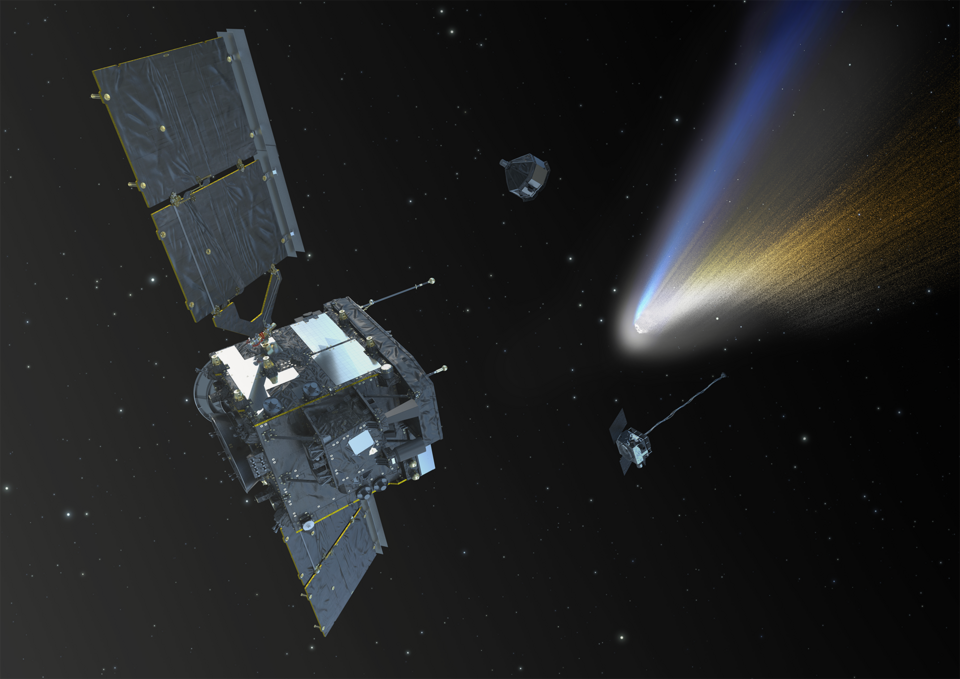
Meanwhile, global collaborative projects, such as ESA’s Comet Interceptor, are working frantically to decode this new information. Amateurs equally provide their own piece of the puzzle with image stacking photometry. With every observation that comet 3I/ATLAS makes as it hastens towards its Jupiter encounter, all previous knowledge that researchers may have had upon interstellar objects—and their origins—could well be rendered obsolete.


