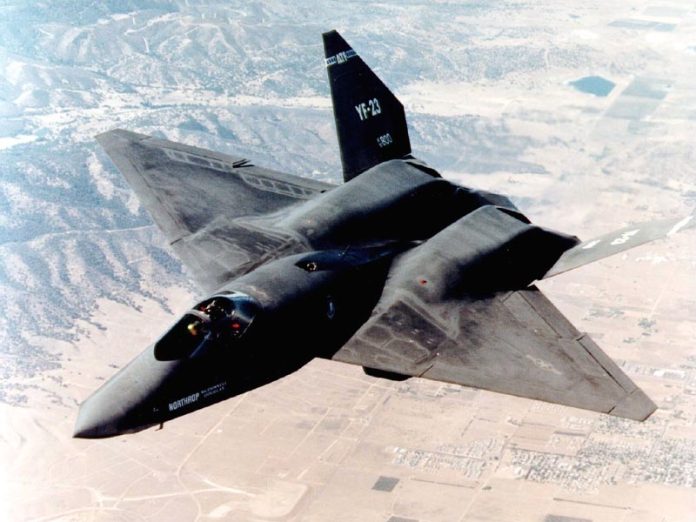
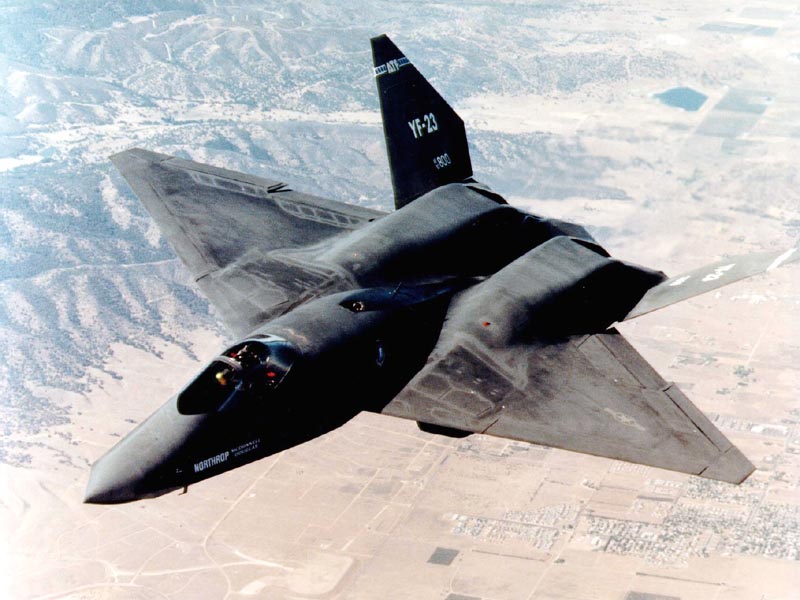
Thirty years after it lost one of the closest fighter contests in U.S. Air Force history, the YF-23 “Black Widow II” could be coming back and this time, onto the flight deck of an aircraft carrier. But like its initial existence, the return of the design in Northrop Grumman’s F/A-XX concept is not only threatened by aerodynamic and engineering hurdles, but a political obstacle course that may kill the program before it ever gets drawn.

1. A Fighter Program in Crossfire Politically
The Navy’s F/A-XX sixth-generation fighter program has become a lightning rod between a Pentagon leadership determined to scuttle it and a Congress ready to pay for it. The Department of Defense contends the U.S. industrial base is not able to absorb simultaneous development of the Air Force’s F-47 and the Navy’s F/A-XX. Critics reply that the problem is not industrial capacity but budgetary will. The Senate Appropriations Committee has already acted to provide $1.4 billion for F/A-XX in the FY2026 defense appropriations bill, matching the Navy’s own Unfunded Priority List.

2. The YF-23’s Enduring Allure
Northrop Grumman’s F/A-XX concept art shows design hints unmistakably YF-23-like specifically, the nose canopy shaping optimized to reduce radar cross-section. The original YF-23, with diamond-shaped wings and low-canted “ruddervators,” was commonly considered stealthier and faster than the victorious Lockheed YF-22, which went on to become the F-22 Raptor. Post-trial accounts indicate it had better side and rear-aspect radar cross-section, longer range, and more efficient supercruise.

3. Why the Black Widow Lost the First Time
During the 1990–91 Advanced Tactical Fighter competition, two YF-23 prototypes PAV-1 “Spider” and PAV-2 “Gray Ghost” were flown with alternative engines: Pratt & Whitney’s YF119 and General Electric’s YF120 adaptive-cycle design. The PAV-2 powered by GE reached a supercruise speed of Mach 1.6, more than that of the YF-22 at Mach 1.58. But the Air Force preferred the YF-22’s thrust-vectoring maneuverability and more advanced systems integration. Lockheed’s capacity to conduct a live missile shot, combined with assumptions of reduced risk and cost, swayed the decision.

4. The NATF-23: A Navalized Black Widow
Northrop also suggested a carrier-capable variant, the NATF-23, to the Navy’s concurrent competition. Modifying the 21-meter airframe to fit a Nimitz-class carrier’s 15–16 meter elevators meant a shortening of the fuselage, expanding the foldable diamond wings, and canards canted for better low-speed handling. The design used thrust-vectoring engines and split weapons bays to carry larger Navy missiles. Wind tunnel testing supported the aerodynamics, but budget reductions and changing priorities terminated the program before production.

5. Stealth through Shape and Signature Management
The YF-23’s stealth benefit came from its planform alignment, edge alignment, and engine integration. Serrated inlets protected fan faces from radar, and the blended, wide fuselage reduced scattering surfaces. Exhaust troughs hid infrared emissions, a key element in countering heat-seeking missiles. These design tenets remain key to current low-observable aircraft, and their reuse in F/A-XX concept art hints Northrop might be using tested radar cross-section reduction methodologies.

6. Propulsion: The Adaptive-Cycle Edge
The GE YF120 engine flown in PAV-2 was a pioneering adaptive-cycle engine, able to transition between high-thrust and high-efficiency flight modes. This capability is now central to sixth-generation propulsion, offering longer range and supersonic cruise times without afterburners. In a Pacific theater of operations, where the carriers will have to stay at longer stand-off distances due to the availability of long-range anti-ship missiles, this efficiency will be the determining factor.

7. The CCA Factor
The Navy contracted Anduril, Boeing, General Atomics, Lockheed Martin, and Northrop Grumman for carrier-based Collaborative Combat Aircraft designs on August 5. These drones are conceived as “persistent, lethal, and agile force multipliers” that will be able to pair with manned fighters such as the F/A-XX. Northrop has an early technical advantage due to its earlier X-47B carrier drone efforts. But some in the Pentagon view CCAs as a less-expensive alternative to a new manned fighter, stealing away money from F/A-XX.

8. Range and the China Challenge
The Navy’s articulated need for F/A-XX is a minimum of 25% more range than existing fighters. This is necessitated by increasing Chinese anti-ship cruise and ballistic missile ranges, compelling carriers to remain further from contested shores. The YF-23’s initial long-range capability, coupled with adaptive-cycle powerplants, matches this requirement. Combining such range with carrier qualification catapult launching, arrested recovery, and corrosion resistance is a significant engineering challenge.

9. Industrial Base and Competitive Dynamics
Boeing’s F/A-XX idea seems to be a navalized variant of its F-47, already on contract for the Air Force. Both contracts with Boeing would provide economies of scale but risk placing too much of the fighter portfolio within one firm. Northrop’s clean-sheet design, perhaps with YF-23 DNA, provides design variety and capitalizes on its disciplined execution of the B-21 Raider stealth bomber.
The F/A-XX choice will decide if the Black Widow lineage at last makes operational service or if it will be an footnote in aviation history. Until that time, its second test this one on the carrier flight deck is as much about budget politics and unmanned incorporation as about stealth shaping and supercruise.


