The U.S. Army sidearm has always lived in a strange space: secondary weapon, primary insurance policy. Rifles usually dominate the story, but pistols reveal something just as important about military design what the Army expected from a weapon when space was tight, time was short, and reliability mattered more than size.
Across more than two centuries, Army handguns shifted from single-action revolvers to high-capacity semi-automatics and, eventually, modular pistols. The five sidearms below stand out not simply because they were issued, but because each one marked a turning point in how the Army thought about power, capacity, ergonomics, or battlefield practicality.
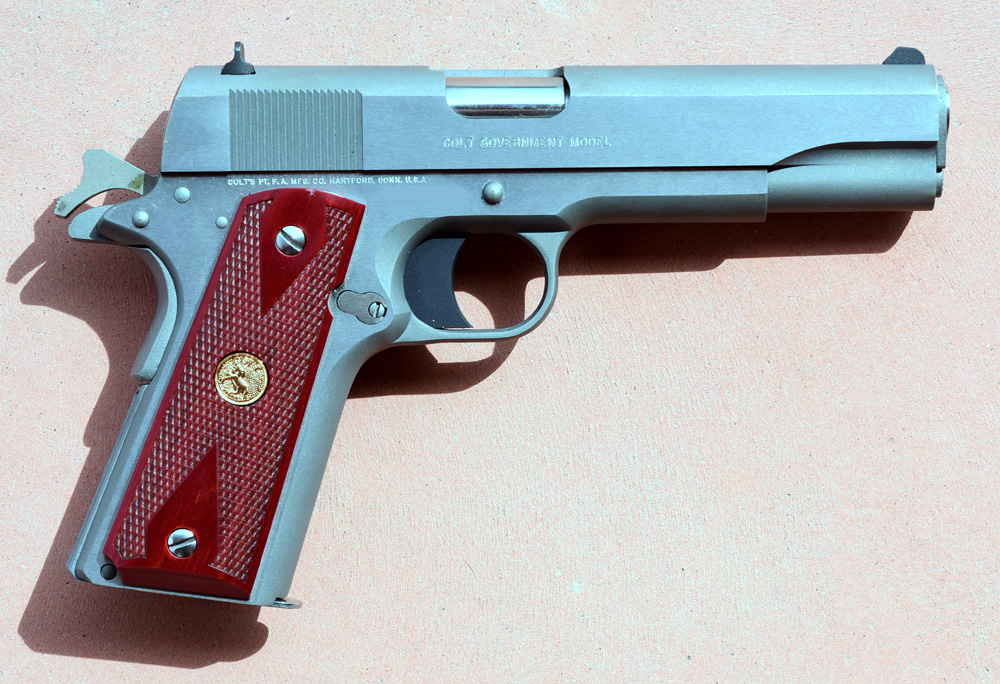
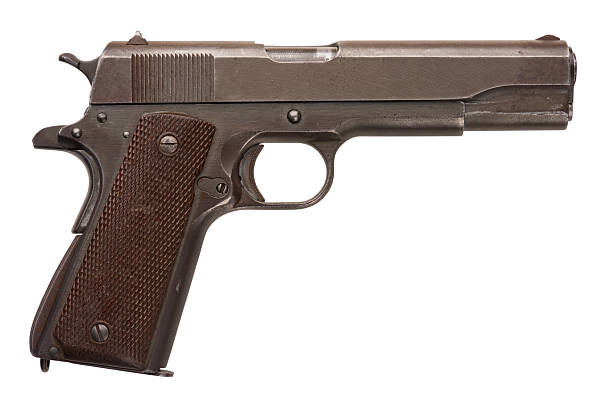
1. Colt M1911 and M1911A1
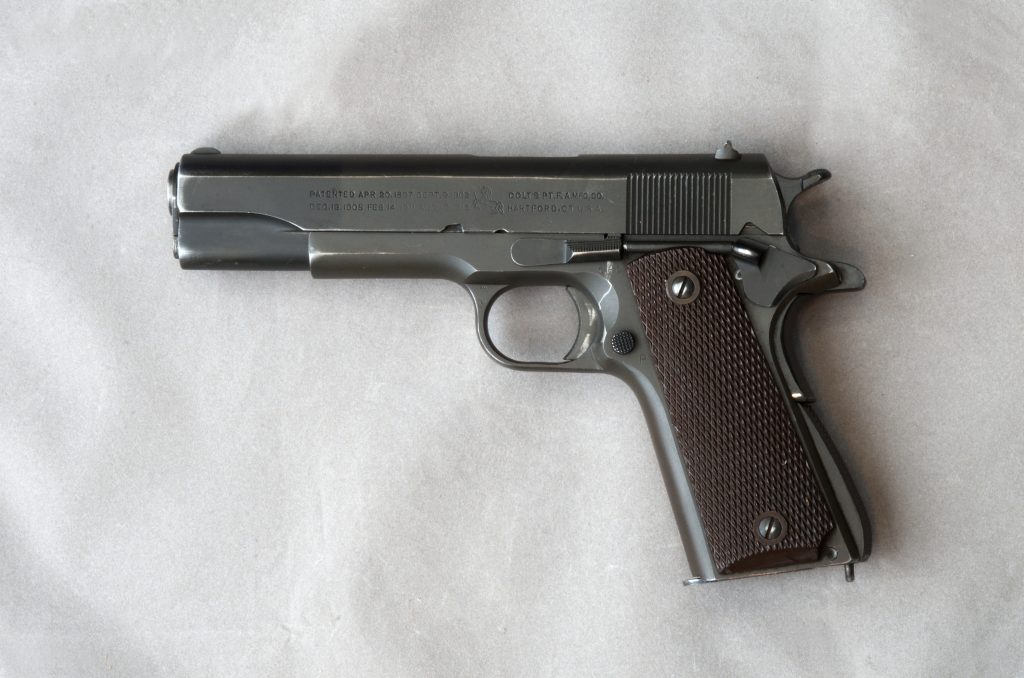
The M1911 remains the benchmark by which American service pistols are still judged. It emerged from the Army’s push for a stronger sidearm after combat experience with the .38 Long Colt exposed serious limits in stopping power, especially during fighting in the Philippines. John Browning’s design answered that demand with a recoil-operated semi-automatic chambered in .45 ACP, and it secured adoption after a famous 6,000-round test without reported malfunctions. Its influence came from more than caliber alone. The pistol combined a manageable manual of arms, rugged steel construction, and reliability that carried it through World War I, World War II, Korea, and Vietnam.
In 1926, the M1911A1 introduced practical ergonomic changes, including a shorter trigger, arched mainspring housing, and improved sights, making the platform easier for a wider range of shooters to handle under stress. This was the Army’s defining leap into the semi-automatic era. The design stayed the standard U.S. service pistol from 1911 to 1985, an extraordinary lifespan for any frontline sidearm. Even after formal replacement, the platform continued in specialized military use, reinforcing just how durable Browning’s basic architecture proved to be.
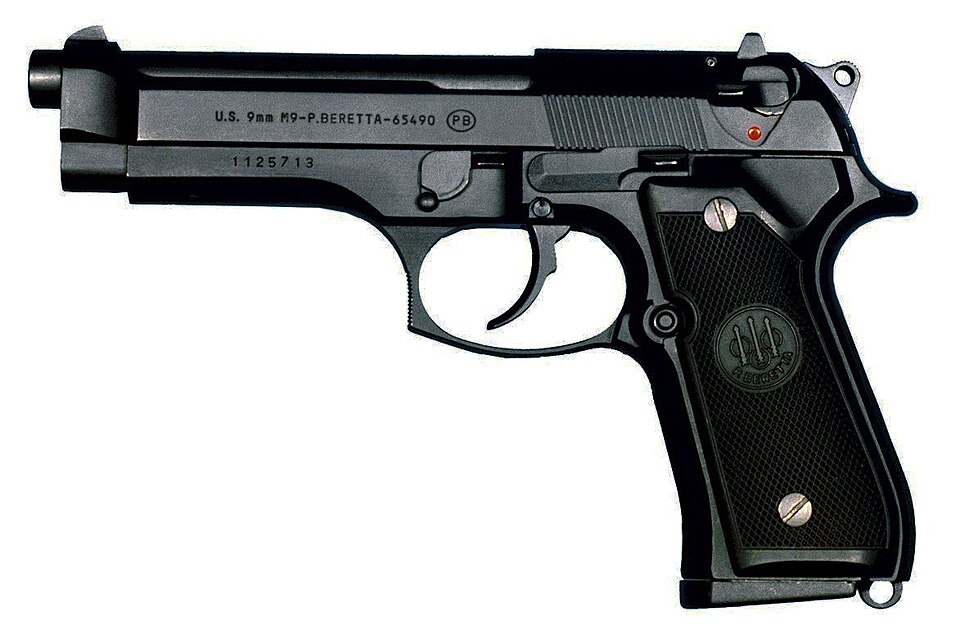
2. Beretta M9
Replacing the 1911 was never going to be simple, and the Beretta M9 arrived with a very different answer to the sidearm question. Instead of a heavy .45 with a seven-round magazine, the Army adopted a 9mm pistol with a 15-round magazine, double-action/single-action trigger, and NATO-standard chambering. That shift reflected a broader change in doctrine: more ammunition on board, easier recoil control, and commonality with allied forces. The road to adoption was contentious, but the pistol itself performed strongly in testing. In the XM9 competition, the Beretta 92F and SIG P226 were both technically acceptable, with the Beretta posting 1,750 mean rounds between failure in final trials before winning on total package cost.
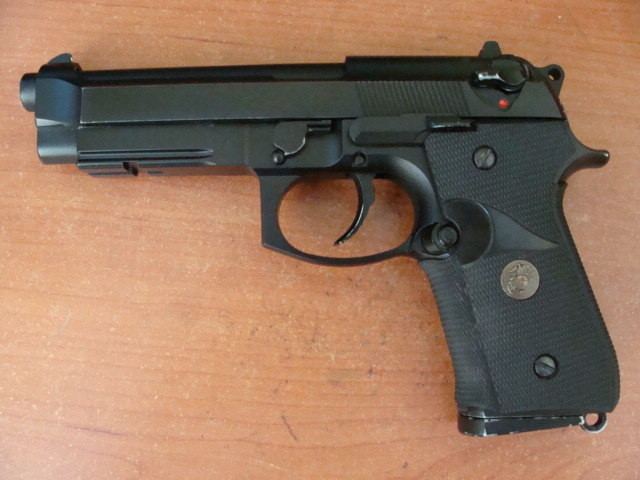
Early slide-failure controversies later damaged its reputation, but deeper examination tied much of that episode to overpressure ammunition rather than a fundamentally unsound pistol design. The M9 then settled into long service across the Cold War’s final years and the post-9/11 era. In Panama, Iraq, Afghanistan, and countless training environments, it became the Army’s bridge between legacy steel pistols and the accessory-ready handguns that followed. The later M9A1, with a rail and improved magazines for dusty conditions, showed how the platform adapted to changing operational needs.
3. SIG Sauer M11
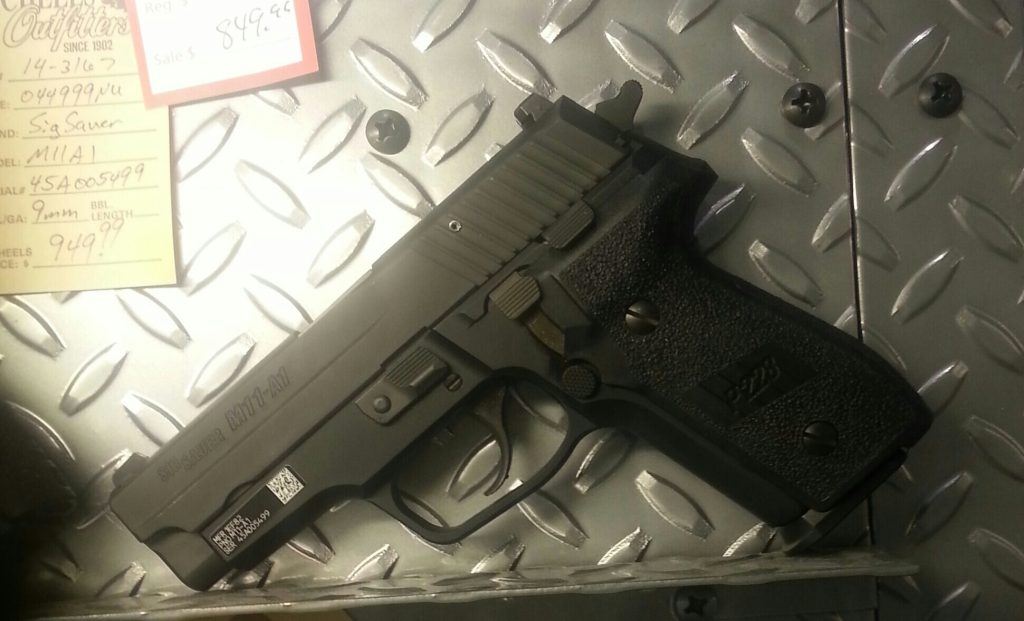
The M11 never became the Army’s universal sidearm, but it filled an important role the full-size M9 did not. Based on the compact P228, it offered a smaller 9mm package suited to investigators, protective details, and specialized users who needed concealability without sacrificing service-grade reliability. Its reputation came from consistency.
Testing at Aberdeen Proving Ground reportedly saw three pistols fire 15,000 rounds with only one malfunction, a result that helped establish the M11 as a dependable compact sidearm for serious institutional use. It remained in Army service for decades with Criminal Investigation Division personnel and other mission-specific users. That matters because it showed the Army was no longer thinking only in terms of one pistol for everyone. The M11 represented a quieter but significant doctrinal point: a sidearm could be optimized for the user’s role, not just issued as a universal backup.
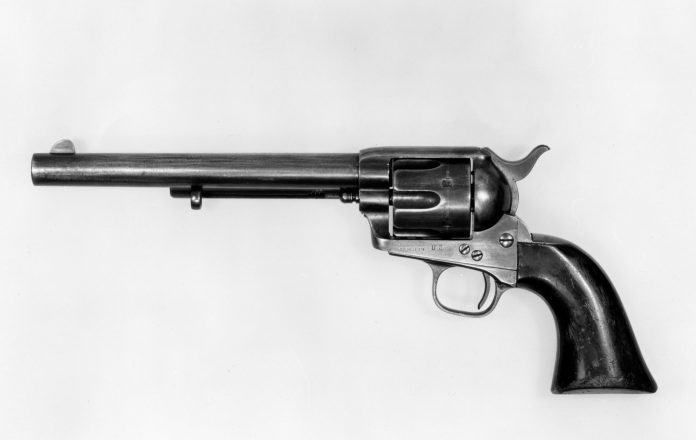
4. Colt Single Action Army
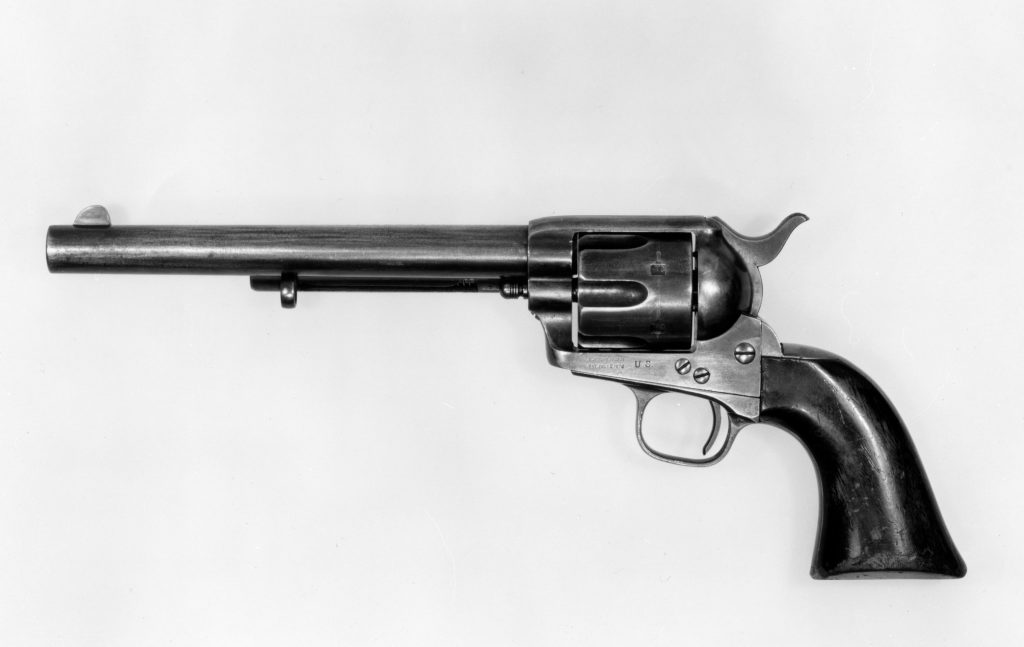
Before the Army’s sidearm became a magazine-fed pistol, it was the Colt Single Action Army that defined the service revolver in American memory. Adopted in 1873 and chambered in .45 Colt, it gave the Army a robust metallic-cartridge revolver at a moment when handgun technology was moving decisively beyond percussion systems. The design’s appeal was straightforward: strong frame, simple lockwork, dependable field performance, and a cartridge with real authority.
The Army used it through the frontier period and well beyond, and its service life overlapped with campaigns that permanently tied it to U.S. military imagery. It also left a long cultural shadow, becoming inseparable from the iconography of the American West. Its limitations were real. Loading through the gate was slower than later swing-out-cylinder designs, and the single-action mechanism demanded deliberate handling. But influence is not the same as technical perfection. The Single Action Army helped define what a durable service handgun looked like in the cartridge-revolver age, and that alone secures its place.
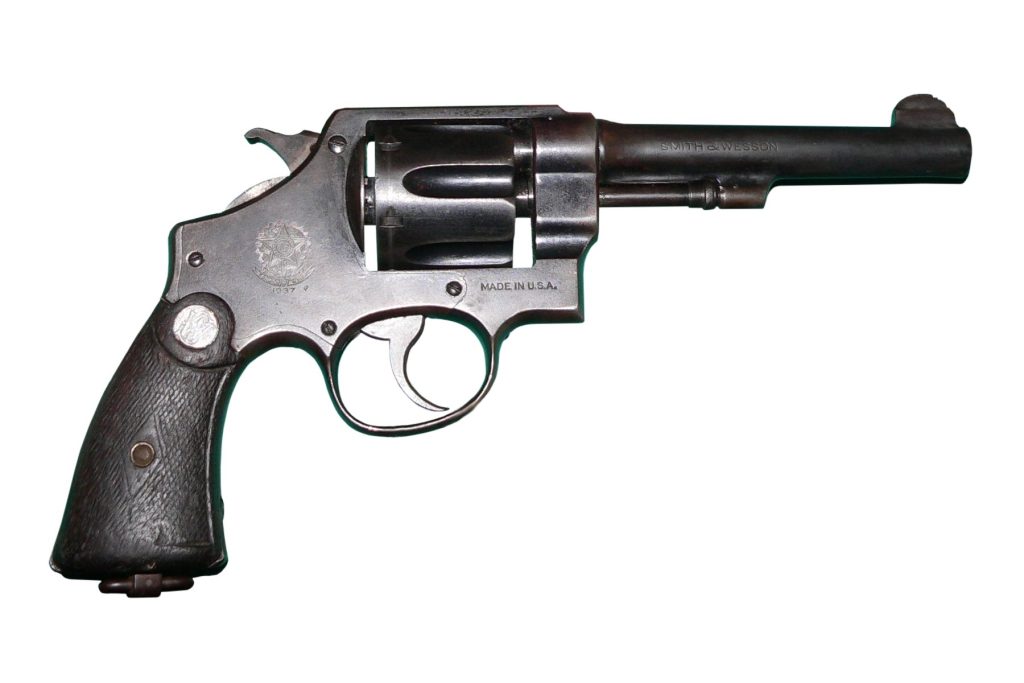
5. Colt and Smith & Wesson M1917 Revolvers
Some of the Army’s most memorable handguns were never meant to be permanent. The M1917 revolvers were wartime expedients, adopted because M1911 production could not keep up once the United States entered World War I. Colt and Smith & Wesson both adapted large-frame revolvers to fire .45 ACP using half-moon clips, solving the problem of running a rimless cartridge in a revolver.
The numbers alone show how substantial the stopgap became. Combined production exceeded 300,000 revolvers during World War I, and the design remained useful well after the emergency passed. These handguns served again in World War II, especially with military police and rear-area personnel, proving that an interim solution can still become a durable part of the arsenal.
The M1917 also demonstrated something engineers tend to appreciate immediately: elegant adaptation under pressure. Rather than wait for ideal conditions, the Army and industry used an existing revolver format, matched it to standard .45 ACP ammunition, and got a practical fighting tool into service fast.
Taken together, these five sidearms trace the Army’s changing priorities across generations. The Single Action Army delivered rugged cartridge-revolver power. The M1917 showed wartime improvisation at scale. The M1911 set the long standard for fighting pistols. The M9 shifted the Army toward capacity and interoperability, while the M11 highlighted the value of mission-specific fit.

The modern Army has now moved on to the modular M17 and M18 family, with the broader services planning up to 421,000 weapons in total. Even so, the older sidearms still explain the logic behind today’s pistol design: a military handgun is never just a backup. It is a compact record of what the service believed soldiers would need when the primary weapon was not enough.


