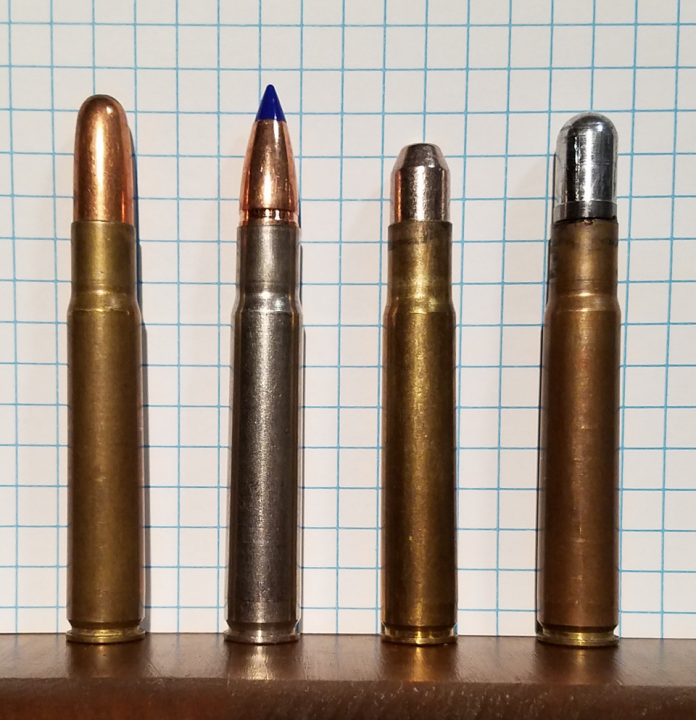

In a hunting world that can’t stop naming the next “must-have” 6.5, a handful of cartridges keep doing the same old job the same old way clean, predictable, and often with less recoil and less muzzle blast than the trendy alternatives.

In a Ron Spomer Outdoors discussion, veteran writer Ron Spomer and his editor Griffin leaned into that reality, reacting to an AI-generated list of underrated rounds. Spomer’s take landed on a simple theme: marketing cycles come and go, but downrange performance still comes down to bullet construction, velocity, and shot placement not whatever happens to be fashionable. These cartridges show what that looks like in practical, field-use terms.

1. 338 Federal
Built around a simple idea take the .308 Winchester case and neck it up to .338 the .338 Federal packs heavy-bullet authority into a short-action rifle. In Spomer’s telling, it remains a personal favorite precisely because it behaves like a hard-hitting woods cartridge without demanding magnum recoil or a long action. He described being “long been kind of peeved” that more hunters haven’t recognized what the round does well.

The appeal is mechanical as much as ballistic: short action, efficient case, and .338-caliber bullets in the 185–225 grain neighborhood that are well-suited for close-to-medium ranges where thick cover turns “flat trajectory” into a footnote. Spomer also cited real hunting use with the cartridge on large game, underscoring that it is not a novelty round it is a packaging choice that happens to work.

2. 7mm-08 Remington
The 7mm-08 follows the same design logic in the opposite direction: a .308 case necked down to 7mm. Spomer called it “just about the epitome of the perfect whitetail rifle,” pointing to the balance hunters tend to chase but rarely name plainly mild recoil, useful velocity, and bullets that carry well without requiring a magnum-sized appetite for noise.
Bullet flexibility is part of the cartridge’s staying power. Spomer noted workable weights from roughly 100 to 175 grains, with many hunters settling into the 140–150-grain range for deer. That “quiet competence” also shows up in broader recoil discussions that stress avoiding flinch as a performance issue, not a toughness contest, including free recoil energy thresholds tied to flinch risk.

3. 35 Whelen
The .35 Whelen is the heavy-hitter that never needed a belt to prove anything. It is essentially a .30-06 case necked up to .358, keeping standard-action compatibility while moving into bigger frontal diameter and heavier bullet weights. Spomer framed it as a “sleeper” for elk, moose, and bear-class hunting especially for shooters who want deep, reliable penetration without stepping into larger, harder-kicking magnum territory.
That reputation is echoed by older cartridge literature that still treats the Whelen as a balanced medium bore. One widely cited description calls it “one of the best balanced and most flexible medium bores for North American big game”, and typical performance examples include a 200-grain bullet at about 2,800 fps. The engineering trade is straightforward: lower-BC bullets shed speed sooner at distance, but inside practical hunting ranges the cartridge delivers blunt-force effectiveness with manageable shootability.

4. 280 Remington
The .280 Remington is often described like a “me too” cartridge, but its geometry has always been purposeful: the .30-06 family case necked down to 7mm, with access to heavier bullets than the .270 Winchester typically stabilizes. In the Spomer and Griffin conversation, the .280’s biggest problem was timing and branding rather than capability arriving late to a party where the .270 already owned the spotlight.

Design-wise, the .280’s advantage is bullet weight range, topping out around 175 grains for hunting use. That point is central in technical comparisons that argue the .280 is more efficient on paper because available 7mm bullet weights expand flexibility for larger-bodied game without forcing a jump to magnum recoil. Griffin also noted the practical quirk of the .280 Ackley Improved: standard .280 Remington ammunition can be used in a properly cut .280 AI chamber, producing usable field performance while fire-forming brass.

5. 257 Roberts
The .257 Roberts “the Bob” is the round that tends to draw blank looks until it’s described: a 7×57 Mauser-based case necked to .25 caliber, known for efficiency, mild recoil, and deer-and-pronghorn practicality. Spomer emphasized that confusion around the cartridge often comes from unfamiliarity, not from any lack of field performance. With appropriate bullet selection and sensible shot placement, it remains a clean-killing option on deer-sized game.
Modern load data still reflects that useful performance window, including published reloading examples showing a 100-grain bullet around 3,028 fps in one recipe set. The cartridge also carries a rare technical footnote: it is one of the few common rifle cartridges to have a SAAMI +P designation, with pressure raised from 54,000 to 58,000 PSI in that specification an unusual marker of how much usable performance was left on the table in earlier factory loadings.

What ties these cartridges together is not nostalgia. It is engineering restraint: efficient case designs, workable bullet weights, and recoil levels that help hunters shoot the rifle they actually carry with the accuracy they actually need. Spomer’s closing theme fits them all: cartridges do not create clean kills by reputation. They do it by launching a well-built bullet at a sensible speed and by rewarding the hunter who prioritizes real-world use over the headstamp.


