Across labs and observatories, a raft of recent results share a common theme: progress is being driven less by a single “big idea” and more by techniques that make stubborn phenomena measurable, comparable, and repeatable. For engineers, that shift matters. It changes what can be validated, what can be automated, and what can scale beyond one specialist team.
From microscopy add-ons built around a rotating LED to space telescopes that can treat a planet’s heat as a proxy for atmosphere, these advances are less about spectacle and more about capability. Each one turns an old limitation-resolution, contrast, detector ambiguity, or signal interpretation-into a workflow.
1. ComSLI fiber mapping that works on regular tissue slides
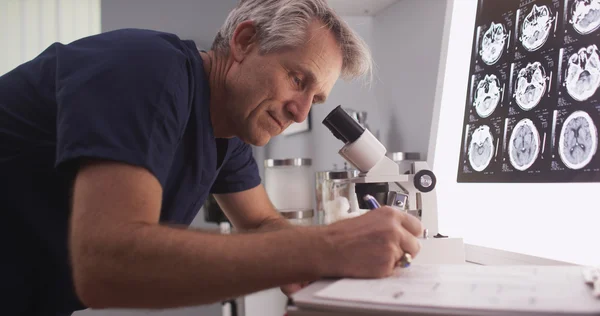
Most tissues derive their shape and organs their function from microscopic fiber networks. Unfortunately, once samples have been processed into standard histology slides, mapping those networks becomes very difficult. An inexpensive, scattered-light approach developed by a Stanford-led team reveals fiber orientations at the micrometer scale, using nothing more than a rotating light source and a camera, to turn conventionally sectioned tissue into structural maps rather than just stained pictures.
The practical engineering hook is compatibility: ComSLI can be applied to slides regardless of stain, preparation or storage history, including a brain section prepared in 1904. That expands the usable “sample inventory” from today’s experiments to decades-or more-of archived material. In demonstrations on the hippocampus-an early-affected region in several neurodegenerative diseases-ComSLI visualized microstructural deterioration patterns that are subtle in brightfield imaging, including a perforant pathway described as “barely detectable” in an Alzheimer’s sample when compared with a healthy hippocampus’s dense interwoven tracts.
Outside the brain, the same approach revealed oriented fiber layers in tongue muscle, stress-aligned collagen architecture in bone, and alternating collagen/elastin arrangements in arterial walls. The implications are workflow-level: a low-cost, fast scan converts histology into quantified orientation data that can be compared across labs, organs, and time, and may support tractography-style reconstructions at microscopic scales.
2. Liquid-argon neutrino detectors that “photograph” rare interactions
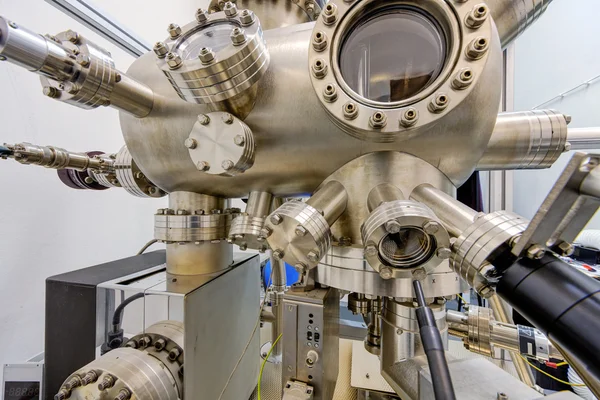
The neutrinos pass through matter in enormous numbers, interacting so rarely that experiments live or die on the basis of detector fidelity. MicroBooNE’s liquid-argon time projection chamber approach captures high-resolution interaction topologies by drifting ionization electrons to readout planes, building 2D and 3D representations that can be algorithmically reconstructed.
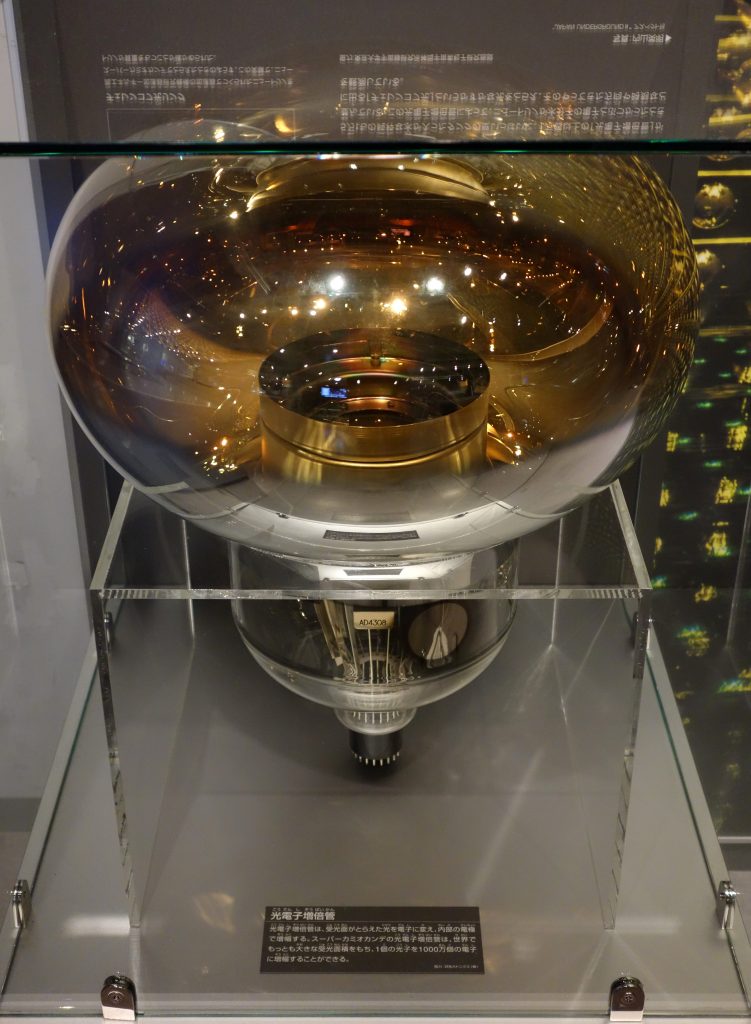
That imaging capability translated into a strong constraint on one popular “fix” for long-standing anomalies. MicroBooNE reported no evidence supporting a fourth, sterile neutrino as the driver behind earlier unexpected measurements, and excluded a single-sterile explanation at 95% certainty, as described in a Nature paper. The broader value for engineering audiences is methodological: when datasets are complex and events are scarce, reconstruction software becomes as central as the sensor hardware. MicroBooNE’s work also feeds forward into larger LArTPC programs by improving how neutrino energy and flavor are inferred from messy real-world interactions.
With future facilities, the emphasis will increasingly shift to calibration, reconstruction robustness, and uncertainty reduction across multiple beams and baselines-problems that look as much like systems engineering as particle physics.
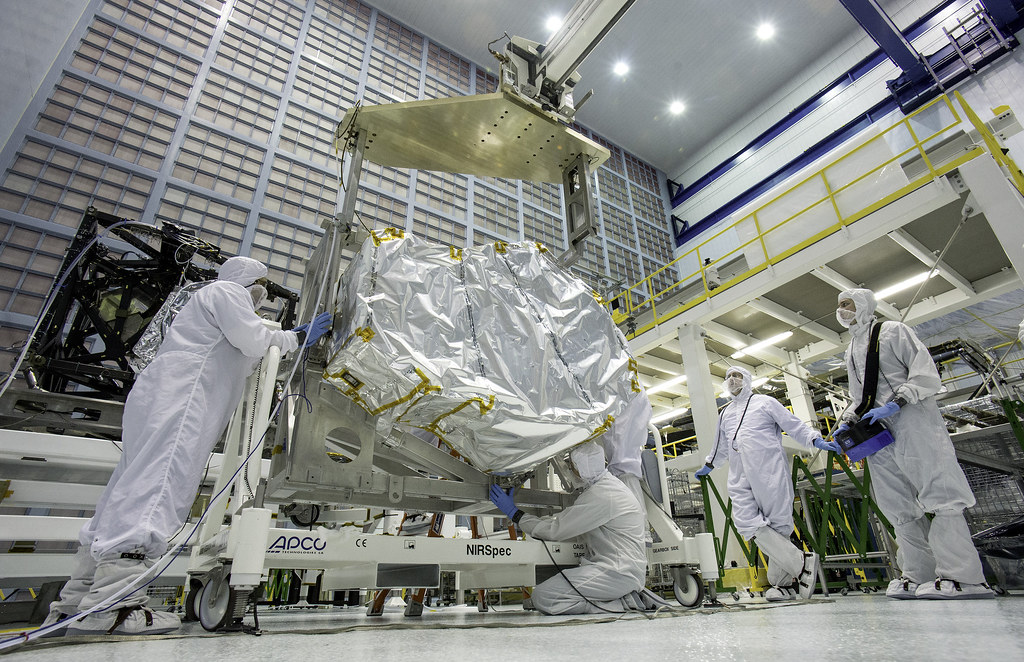
3. JWST thermal “day-night accounting” for rocky exoplanet atmospheres
The small rocky planets extremely close to their stars have often been treated as likely airless: too hot, too irradiated, too leaky. JWST is changing how that assumption gets tested, using thermal emission measurements as a stand-in for one of the jobs of an atmosphere: heat transport.
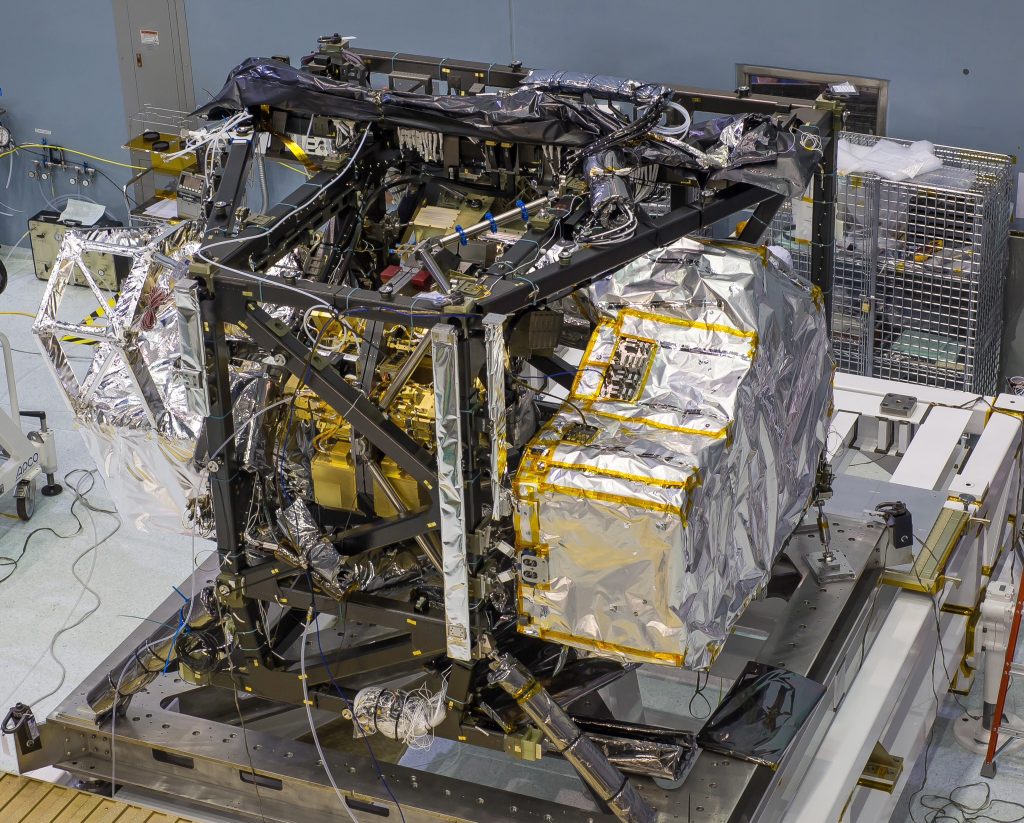
For the ultra-short-period super-Earth TOI-561 b, observers used NIRSpec to measure the dayside temperature via the system’s brightness drop when the planet moved behind its star. The result-about 3,200°F (1,800°C) rather than a bare-rock expectation near 4,900°F (2,700°C)-implies substantial cooling and redistribution. The team concluded that a “thick volatile-rich atmosphere” best explains the observations, with winds transporting heat to the nightside and gases absorbing near-infrared light before it escapes.
This is instrument-driven inference: rather than “seeing” air directly in the familiar sense, the telescope reads a planet’s energy budget. It is also a reminder that remote sensing often advances by selecting observables that are hard to fake-here, a temperature mismatch that demands physics beyond a glowing rock surface. The work is summarized in observations of TOI-561 b that push rocky-atmosphere studies into regimes previously written off.
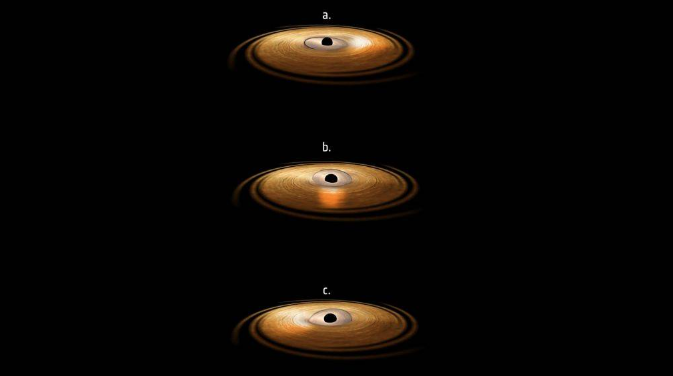
4. Frame-dragging detected via synchronized disk-and-jet wobble
General relativity predicts that rotating massive objects twist spacetime and that this induces frame-dragging, or Lense-Thirring precession. The challenge has been isolating an observational signature clean enough to attribute to the effect rather than to messy astrophysical variability.

Researchers described rhythmic X-ray and radio changes in the light curves of a tidal disruption event, AT2020afhd, that would indicate the accretion disk and jet wobble together on a 20-day cycle. The study used X-ray data from Swift and radio measurements by the VLA to characterize coupled motion and used it as evidence for a spinning black hole dragging spacetime around itself.
“Our study shows the most compelling evidence yet of Lense-Thirring precession-a black hole dragging space time along with it in much the same way that a spinning top might drag the water around it in a whirlpool,” explained Dr. Cosimo Inserra, one co-author framing the significance in engineering-friendly terms of mechanism and analogy. The publication in Science Advances underlines a broader trend: multi-band time-domain observations can convert exotic relativity effects into measurable periodicity which can then, like any other coupled dynamic system, be modeled and stress-tested.

5. Food-coloring transition as manufacturing and QA redesign problem
The health controversy over color additives is quite different from the industrial reality of engineering: supply chains, formulation stability, and quality assurance. Regulators in the U.S. announced steps to phase out synthetic dyes derived from petroleum and to hasten approvals for natural alternatives, including announcing an intent to remove several certified dyes from the food supply on a defined timeline.
The measure outlines a transition away from dyes such as FD&C Red No. 40, FD&C Yellow No. 5, and FD&C Blue No. 1, while also moving to revoke authorization for Citrus Red No. 2 and Orange B. It also points to fast-tracked review for natural colorants and increased research on impacts to children’s health and development. Such details matter, since natural pigments often behave differently under heat, light, pH changes, and shelf-life demands, forcing changes in process parameters and packaging choices rather than a simple ingredient swap. Separate technical context explains why this domain is hard to “solve” with a single study: safety assessments typically rely on toxicology thresholds and intake modeling, while evidence for neurobehavioral effects varies by study design and susceptible subgroups.

That tension is summarized in clinical and regulatory background, which describes how the FDA derives acceptable daily intake and how research has evolved around behavioral outcomes. The official policy direction is captured in measures to phase out petroleum-based synthetic dyes, which effectively reframes food color as a compliance-driven engineering project spanning R&D, procurement, and QA. Taken together, these developments share a practical throughline: they are not single-purpose discoveries but platform capabilities. They turn elusive structures and signals into datasets that can be archived, reconstructed, compared, and scaled. For readers of Modern Engineering Marvels, the impact that most endures is a common one: whenever the means of measurement either gets cheaper or clearer, the number of questions which can be asked and answered increases faster than anyone can predict for any one discipline.


