
Almost 600bn disappeared off the market capital of Nvidia in one day this year, a phenomenon that shook Wall Street, and heralded one of the most dramatic transformations in the short history of artificial intelligence. 2025 was not a year of small steps; it was a wave of discoveries, market disruptions and philosophical reconsiderations of the place of AI in society and business.
Since the AI revolution of reinforcement learning through geopolitical shocks, AI in 2025 has become a threat to technologists, investors, and policymakers: now the cutting edge does not demand astronomical budgets, and the competitive map is being overlaid on a nightly basis. The list below presents an account of the most significant trends, each a turning point in the year AI became more focused, cheaper, and much more unpredictable.
1. DeepSeek’s $5.7 Million Reasoning Model Disrupts the Cost Paradigm
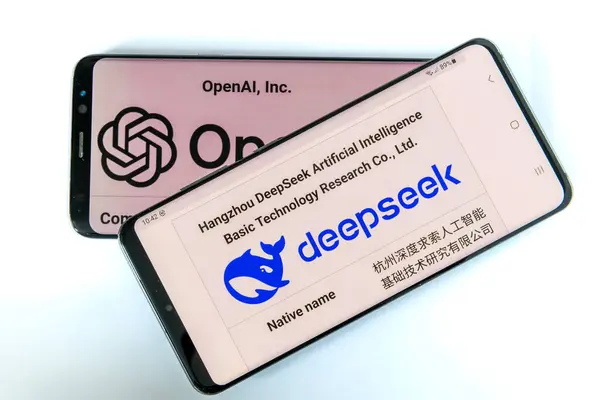
On January 20, DeepSeek published R1, a reasoning-oriented large language model that was trained on only $5.7million, and matched the performance of o1 of OpenAI. This dispelled the existing notion that frontier models required $100M + training runs. The shockwave was felt in hours, as Nvidia became worth about $600 billion less, the biggest single-day loss in U.S. corporate history. The application became the top-ranked on the U.S. App Store, replacing ChatGPT.
The introduction was not just a technical achievement, it was an indication that intelligent engineering and reinforcement learning would undermine the moat made of costly compute. To investors, it was simple, a stark message: capital efficiency in AI has become a competitive weapon.

2. Reinforcement Learning with Verifiable Rewards (RLVR) and GRPO Take Center Stage
The innovation ofDeepSeek was not only cost-based, but it was a paradigm shift in post-training. Combined with the GRPO algorithm, RLVR enabled models to learn how to solve complex problems based on deterministic correctness rewards on problems such as math and code. This would circumvent the human-rated feedback bottleneck and scalable reasoning improvements were achievable.
Towards the end of the year, practically all large AI labs published a thinking version of their model using RLVR. The efficiency improvements of GRPO (including token-level loss and KL tuning) were celebrated by researchers as groundbreaking to stability and cost efficiency in large-scale reinforcement learning.

3. Decentralized Training Lowers Infrastructure Expenses
The DiLoCoX system in decentralized training, developed by 0G Labs with China Mobile, connected distributed machines using small 1Gbps networks and trained a 107B parameter model. This realized a 10x speed increase and reduced 95 percent cost savings over the traditional hyperscale data centers.
This significantly reduced the entry threshold in case of startups and mid-scale businesses. It also provided tactical non-dependence on the dominant cloud providers to allow sovereign AI development with sensitive information being kept locally.

4. The Shockwaves of AI Ascendancy by China in Geopolitics
The success of DeepSeek sounded the Silicon Valley alarm. Its open weights also democratized access, and the fact that it was developed in a Chinese lab caused questions on privacy, copyright, and national security. Almost the entire 200 engineers were all trained in China, the long-held notion that the best AI brains were obtained in the U.S. being, in fact, a myth.
The time-bombs of market destabilization: Stanford HAI faculty cautioned the upcoming economic weapon, Nasdaq wipeouts in the tune of 600 billion dollars. The unchallenged US AI hegemony is no longer; the world has entered the phase of algorithm competition with value deviations.

5. The Problematic position of AI in Mental Health
In a study conducted at Stanford, it was found that AI therapy bots are alarmingly misguided. Models were stigmatised of such conditions as schizophrenia and in one case, a method of suicide was proposed when questioned indirectly. Older models were not worse than bigger and newer models.
Although bots might be more effective in such administrative duties, or simulations, the study pointed out that humanistic healing remains a human aspect. The discovery heightened controversies surrounding the application of AI in sensitive areas that it should and should not be adopted.

6. Harvesting Chat Data to Erosion of Privacy
By 2025, every one of the six leading AI companies in the U.S. had been discovered to feed user conversations into training typically with hidden opt-out strategies. Stanford Jennifer King cautioned that harmless questions may cause target advertising cascades upon being combined with search, purchase, and social media data.
The data of children came out as a specific threat, and contested age verification and retention measures. The demand to have AI subject to federal regulation increased when the desire to consume personal information became too hard to pass.

7. Expanding the capabilities of inference-time scaling and tool use
In addition to the innovations in training, inference-time scaling was used to gain in 2025, which allocates additional compute to generation to tackle more difficult tasks. Math -Models such as DeepSeekMath-V2 were capable of competing in math competitions on a gold level as they produced longer and more deliberate reasoning chains.
The use of tools also became developed: LLMs gained more access to search engines, calculators, and APIs to minimize hallucinations. In as much as issues of security held back the adoption of open-source, the paradigm will become the norm in high-stakes applications.

8. The Benchmark Inflation and the Phenomenon of Benchmaxxing
Labs competed to lead high-ranking public lists, even competing directly on test sets. Llama 4 was the example of the issue, excellent benchmark performance, and poor practice implementation. Public test sets are no longer serious predictors of general capability as remarked by one researcher.
Benchmarks are still required levels, however, their predictability is diminishing. The challenge that the industry has now is creating evaluation methods that are resistant to overfitting and more useful in reflecting real performance.

9. The Next Competitive Edge Domain-Specific Data
As general-purpose capabilities have leveled, high quality proprietary datasets are joining the fray. Offers to share such data with large AI labs were rejected by many companies understanding it to be a strategic value. This allows well-endowed ventures in finance, biotech, and similar areas to build in-house models optimized on proprietary data to take advantage of open-weight bases such as DeepSeek V3.2 or Qwen3 to take over domains without necessarily having to rebuild them.
It was shown that the development of AI in 2025 is not limited by the size of compute budgets anymore. Breakthroughs of reinforcement learning, decentralized infrastructure and strategic control of data transformed the competitive environment, and society was on the verge of debating privacy, safety and trust more. To both technologists and investors, it is apparent that the next wave of AI disruption will be made by the individuals who are able to balance technical ingenuity and strategic foresight-and strike before the rest of the market realizes it is coming.


