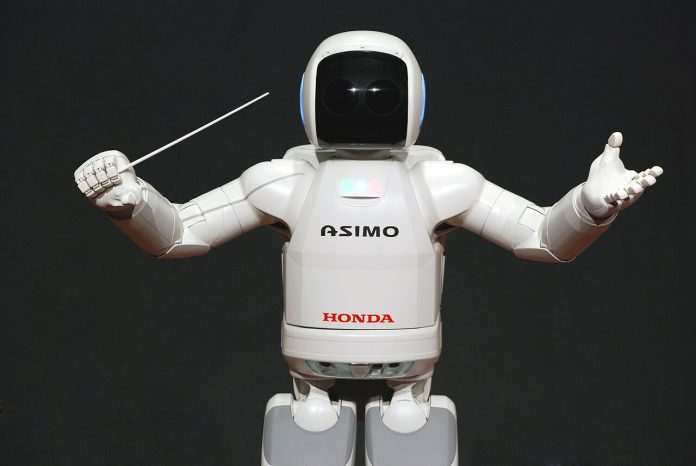

All the humanoid robots offering greetings and cups of coffee at the largest robot exhibition in Japan last December were imported from China. When Japan was dubbed the “Land of Robots” for its groundbreaking robot icons such as Honda’s ASIMO, it is now being eclipsed, especially in the rapidly growing robot industry projected to reach a staggering $5 trillion by 2050, led by China and the US.

1. Humanoids as the Physical Bodies of AI
Artificial intelligence has transitioned from living on computers and server screens to humanoid robots, which have taken the place of the physical bodies of AI systems due to the integration of large language models and vision and motion control capabilities to interpret the surroundings and perform tasks independently. This has resulted from the ability to interpret the surroundings independently and perform tasks ranging from warehouse logistics to customer services.

2. Chinese Models Sweep the Exhibition Floor of Japan
Tokyo 2025 hosted six humanoid robots showcased by GMO Internet Group at the International Robot Exhibition, all of which were made in China. Unitree G1 measured 130 cm with a 35-kilogram weight and demonstrated stable locomotion, object transfer, and even some choreographed dances. The technical platform designs consist of three-fingered manipulators, two hours of battery life, and 7.6 kph speed. Unitree has continued to develop its ecosystem with the launch of the world’s first app store for humanoid robots and opens up the possibility of downloading task modules that should include domestic work or maybe even industrial tasks in the future.

3. American Advances in Industrial Deployment
Meanwhile, Chinese humanoids are entering consumer and service sectors, and U.S. companies are promoting validation in industry applications. Agility Robotics’ Digit has already transported more than 100,000 totes at a GXO Logistics site doing “last meter” work needing humannon-like hand dexterity – filling a niche between AMRs and manipulator robotic arms. Such quantifiable performance builds confidence in humanoids as a viable production floor resource and further develops trusted safety parameters allowing co-working with human employees.

4. China’s Embodied AI National Strategy
Beijing views AI-a as “a platform for national economic renewal, fixing its demographics challenges, and military transformation.” It advises in its government playbook “provincial specialization, with Shanghai focused on sensor AI, Guangdong and Zhejiang on general-purpose humanoid robots, and Beijing hosting high-performance AI processors.” Some firms, including UBTech and Unitree, are developing AI-a in humanoid robots with capabilities such as UBTech’s Walker S2, “designed to operate continuously for 24 hours in factories without changing batteries.”

5. Technical Foundations: Actuators, Sensors, and Locomotion
The source of powered articulation in modern humanoids will come from high torque and electrical actuation. Sensing of six-axis force will provide adequate handling for precision when dealing with objects in the environment. LiDAR or stereo vision will offer functionality for spatial maps to guide the movement of G1 among different terrains and spaces. Algorithms for locomotion will require features for balancing and adapting to dynamic gait to allow G1 to move among different terrains and spaces effectively in an environment filled with objects and other human beings.

6. Global Supply Chain and Localization
Chinese strengths are their massive manufacturing base and subsidized supply chains in embodied AI hardware. Localization of critical components, such as LiDAR and torque sensors, reduces reliance on imports and fast-tracks scaling. Industrial depth and availability of real-world application scenarios thereby create abundant data sources necessary for training embodied AI systems.

7. Japan’s Strategic Crossroads
According to Mana Hanamura, of Deloitte Tohmatsu Venture Support, Japan does not need direct competition with the Chinese and Americans in the robotics field. The nation can focus on fields of automation that suit its interests, including elderly care, response to disasters, and the production of high-quality components. Though Japan has the experience of its robotics engineering background that would help the nation in the field, without proper strategies, the nation’s contribution to the market of humanoids could further decline.

8 Applications Expanding Beyond the Industry
Humanoid robots may be ready for the most dangerous areas and carry out customer-facing service roles and/or domestic care. AI-implemented humanoids could provide assistance with mobility, surveillance, and companionship for eldercare, along with the strengths from Japan on safe and human-centric design. The humanoid with enhanced locomotives and full sensory systems may enable the ability to navigate rubble, deliver materials, and situation awareness for rescue teams in the aftermath of tragic occurrences.

9. Competitive implications
A scaled AI with embodied solutions achievable in China prior to the competition could have utter control over the chains of supply worldwide, including the same dependencies being created for the use of 5G and solar technology. The U.S. focus on validation and safety may provide sound models for deployment.
Moreover, the route from Japan on special applications with innovation on levels of components constitutes a challenge that is hardly about making the robots but about determining the physical representation of AI within the real economy with lasting technological impact.


