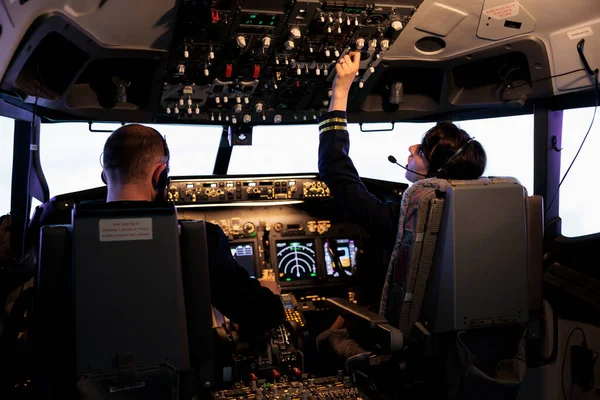
Instead of trying to determine if artificial intelligence has a role within it, the aviation industry is slowly implementing it into its decision-making processes. The IATA is forecasting a sharp rise of 4.9 percent in passenger traffic annually up until 2026. The problem of capacity and the problem of a shortage of manpower caused the industry to turn to artificial intelligence as a possible solution. This is being implemented in turn-around management, disruption management, artificial intelligence-based maintenance, and safety.

1. Turnaround and Gate Allocation by AI
Turnaround delay is one of the most wasteful trends happening in the aviation industry, with a cost associated with it presently pegged at $100 a minute. AI-based solutions such as turn-around management solution provider Assaia, with its computer vision technology-based solution implementation at Dubai International Airport, are utilizing computer vision technology that assists in ramp activity tracking, thus allowing identification of turnaround delays related to de-boarding, fueling, and baggage handling. In airports with heavily banked waves, such as Dubai International, where Emirates is operating, a turnaround time of up to five minutes can have a normalizing effect on the entire wave.

2. Predictive Disruption Management
Statistics show that approximately 59% of flight delays can be controlled and that weather is not considered an issue in this field. “The job of AI in the business of disruptive prediction is the identification of precursor signs that may involve crew disagreements, schedule overruns, or airspace density, and making these predictions before the event.” “The Integrated Airport Predictive Operations Centres (APOCS), such as at the Indira Gandhi International Airports, bring together AI-optimalized weather forecasting systems, CAT-III Landing Solutions, and gate allocation analyses, ensuring the preservation of air transportation capacity irrespective of unfavorable weather conditions.” EUROCONTROL’s AI-based ATM system further improves the predictability of flights by predicting an increase in “air transport volume generated by a large number of flights” by routing flight paths away from any given potential capacity risk.

3. Generative AI for Maintenance & MRO
Out-of-service occurrences can ground planes for days. Maintenance co-pilots are now being benched due to days-long occurrences. “Maintenance co-pilot” generative AI is being leveraged. Unstructured data is processed from manuals, problem reports, or sensor readings. Maintenance reliability professionals are leveraging AI. These professionals currently leverage AI to examine repairs numbering in the thousands per year. One airline, an aircraft maintenance operation, is now pilot-testing the use of gen AI. These benefits will immediately lower problem-solving time by as much as 35%. This is required due to staffing shortages projected to leave 20% of the labor force open as of the year 2033.

4. Architecture & Governance of the Data Pipeline
Precision depends on the quality of the data used in AI applications. Forecasting also predicts that 60% of AI projects will be shelved by 2026 due to poor quality of data used in these projects. The aviation industry has a challenge of integrating their legacy application data streams in a manner that ensures synchronization and scheduling information, maintenance information, and employees’ movement information are appropriately available. Cloud integration platforms and governance systems conforming to ISO/IEC 42001 are on the cusp of standardization and are poised to provide quality and trustworthy data required by AI applications to run properly on these platforms. Airlines following operational intelligence by OAG are following the correct strategy to scale up their AI application deployments beyond proof-of-concept projects.

5. Frameworks of Arrangements of Regulations
FAA’s “Roadmap for Artificial Intelligence Safety Assurance” and “EASA’s AI Roadmap 2.0” have risk-based and rolling out strategies for AI with low-risk applications, such as predictive maintenance. They also show a focus on the explanation of “learned AI” and “learning AI” in relation to the requirement of monitoring and the avoidance of unsafe learning. Adherence to the “ISO/IEC 23894 standard for AI systems” provides information on AI ethics and safety requirements. “NIST-AI-600-1 provides guidance on data poisoning for the application of generative AI.”

6. AI Based Cybersecurity & Trust
The rise in the incorporation of AI into air transport infrastructure gives rise to this vulnerabilities rate. The incidence of cyber incidents, ranging from GPS/GNSS spoofing attacks to ransomware-based threats to airport infrastructure, could be regarded as possible safety margin degraders. The FAA has initiated work on its new Cyber Security Data Science program in its aim to model aircraft system data to make it possible for AI to foretell system breach vulnerabilities even before damage has been incurred. Applications of zero-trust networks, AI-based video analytics solutions, and perimeter intrusion detection solutions would be common in airport IT system upgrades. Concerns on the part of high-end Air Services providers, especially among Gulf states, imply that AI applications would be expected to ensure reliability regarding punctuality and safety to forestall quick regulatory responses to uncertainty threats.

7. Biometric Processing and Passenger Flow Optimization
Document-free travel corridors, already in action at DXB via Emirates biometric facilities, integrate facial recognition technology and AI-based identity verification and facilitate passenger processing via 200 cameras at an installation cost of $23 million. Since the passenger count approaches 150 million by 2032, AI-based biometric passenger processing creates an environment with reduced queues and devoting more time to other unexpected events of operation. The digital twin analysis of the operation of the terminals, already in action at the Hyderabad Airport, assists in carrying out passenger flow analysis and simulates the process to change passenger handling from a reactive process to one of predictions.

8. Integrated Risk Management through AI
There are emerging risks such as cyber risks, environmental risks, and geopolitical risks, and these are very much interlinked in such a manner that they cannot be captured in one system dealing with safety risks. Integrated methods need to be adopted in managing risks. For example, methods adopted in IRRM by IATA encourage one thing – an overall safety, security, and emergency response risk management scheme. AI’s contribution is nothing but amalgamating data such as cyber events, safety reports, and environment information in one single form of overall risks.

Graph tools and LLMs have already identified so-called “induced events” associating GNSS Jamming and Separation Minimum Violations. There is no innovation behind AI in the aviation world. Starting from air terminal operation right up to government regulations, AI is imminent; in fact, AI appears as the bridge to amalgamate efficiency, safety, and resilience as one.


