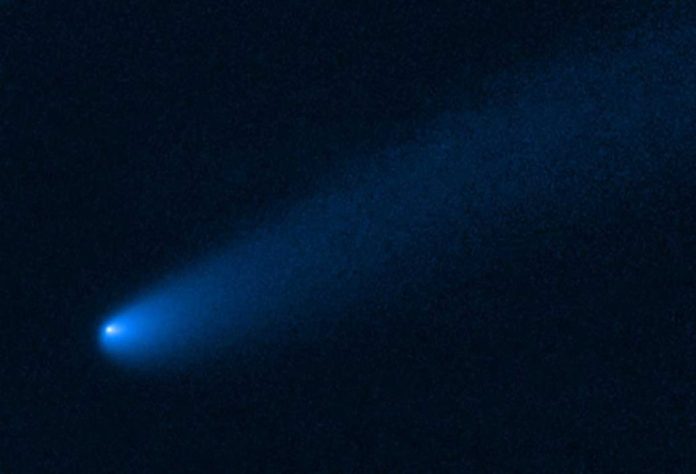
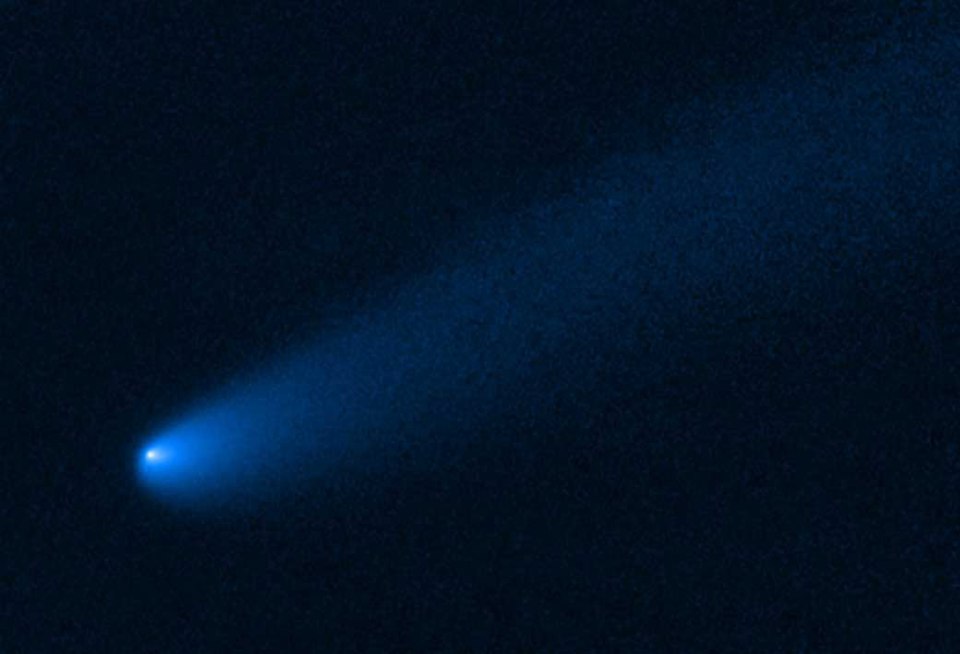
In its dying throes, a comet can write its own autopsy in dust and ice. The Hubble Space Telescope has captured one of the best-resolved, most-detailed records ever made about the breakup of Comet C/2025 K1, entailing the mechanical and thermal processes involved in tearing the icy body to pieces after its plunge toward the Sun.
1. A Rare Opportunity in the Inner Solar System
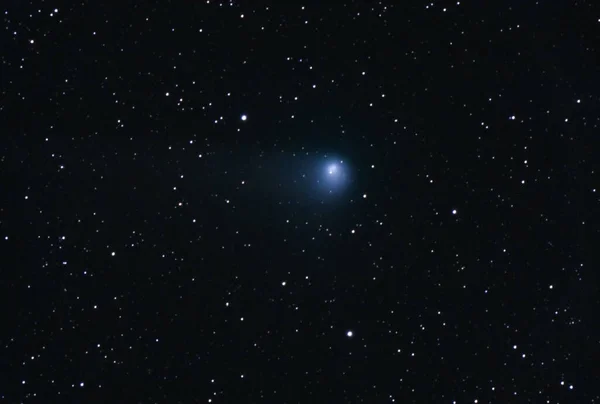
ATLAS was a long-period comet from the far-flung Oort Cloud. It approached perihelion on October 8, 2025 at a distance of only 0.33 AU from the Sun. It swooped within 49 million kilometres from the Sun-much closer than the typical orbit of Mercury-and exposed its porous, volatile-rich nucleus to intensive solar heating and gravitational stress. Its breakup happened very close to Earth, and such a bright, accessible target was well within both the purview of ground-based telescopes and Hubble’s high-resolution imaging instruments.
2. Hubble Resolves ‘Mini-Comets’
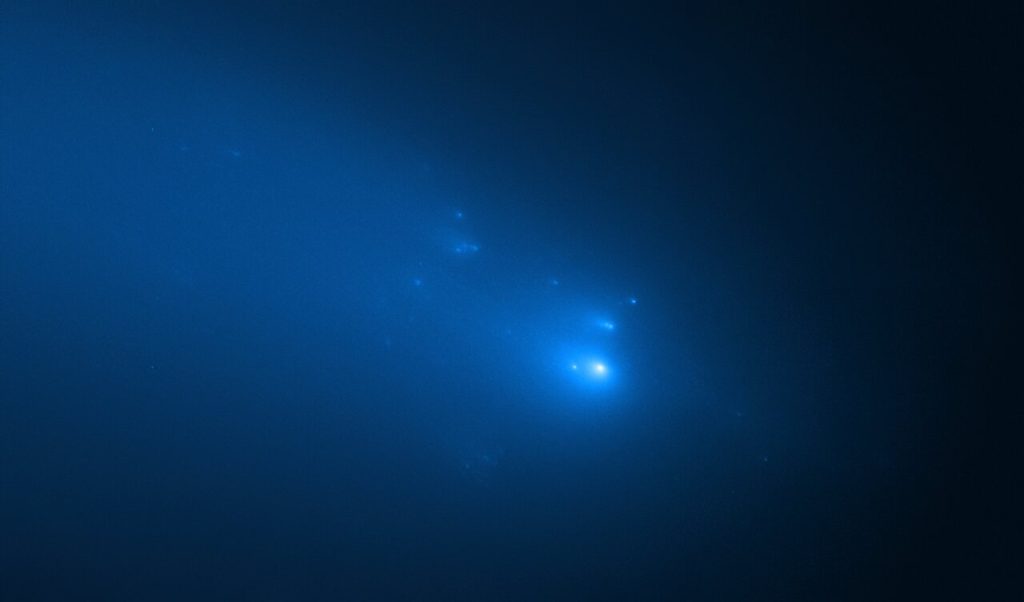
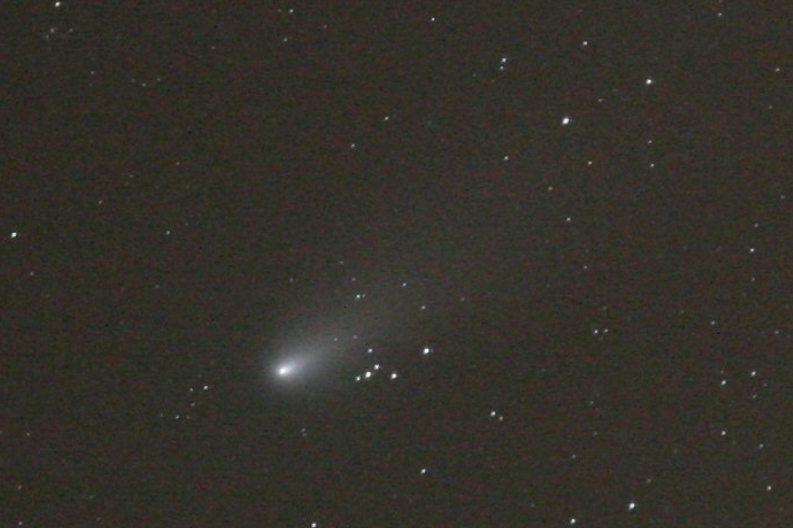
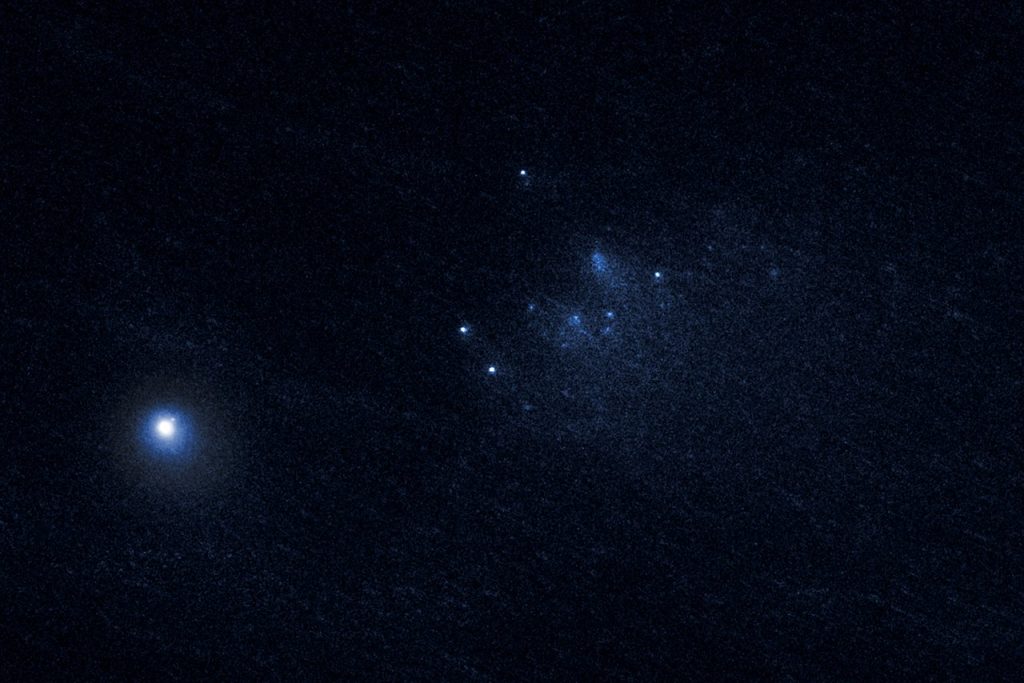
“With Hubble we are finally able to resolve individual mini‑comets,” said Astronomer Ye Quanzhi. Over three observing epochs from November 8–10, the Hubble Space Telescope’s STIS instrument differentiated at least five major fragments each enveloped by its own coma: The largest pieces were ~1.7‑km in effective radius, while the smallest were only ~0.4 km. The 0.15″ point‑spread function corresponded to 68 km at the comet’s distance and allowed for the separation of fragments only hundreds of meters apart a resolution not possible from the ground.
3. Hierarchical Fragmentation and Motion
This fragmentation was hierarchical. The main break-up most probably happened on November 1, in which kilometre‑sized pieces were thrown off at 3–4 m/s. Smaller and swifter pieces, such as “IV,” broke off earlier at as much as 10 m/s and faded away quickly. A secondary fragmentation of fragment II into IIa and IIb happened between November 8.56 and 9.82 with a very gentle 0.5 m/s, near escape velocity, before IIb brightened so enormously. Progressive disruption of such a kind has also been seen for other comets, for example 73P/Schwassmann‑Wachmann 3, but here the timescale was within days of each event.

4. Delayed Dust Production: Thermal Physics in Action
Indeed, photometric analysis showed that physical breakup was invariably followed after 1–3 days by an enhanced dust release. Similarly, thermal modeling for diffusivities κ ~ 10⁻⁷–10⁻⁸ m²/s shows that many rotation cycles are needed to penetrate centimeters into newly exposed subsurface ice to ~180–200 K, the temperature at which H₂O can sublime rapidly at 0.9 AU. Hence, fragments appeared inert immediately after separation but developed bright comae days later.
5. Arclets as Evidence of Initial Surface Warming
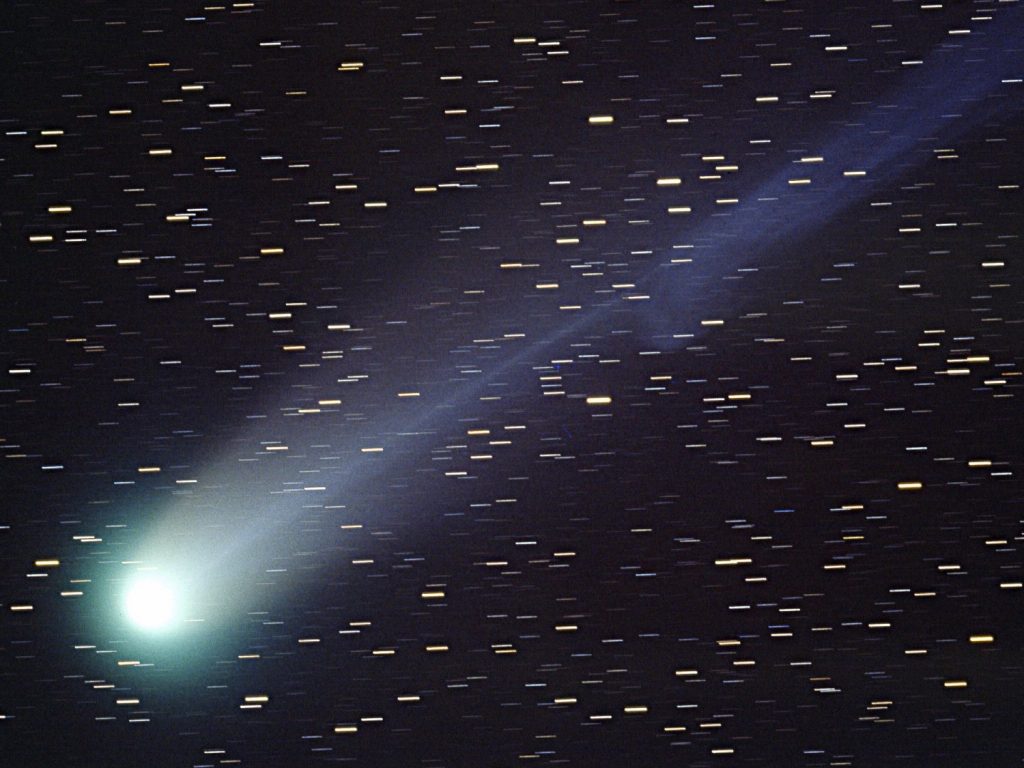
Fragment I displayed during the first Hubble epoch thin, all-but-stationary arclets roughly perpendicular to the dust-tail direction. Geometrical considerations and a lack of outward expansion rule out gase-driven pressure waves. They are instead in agreement with confined dust shells ejected at the time newly exposed surfaces first warmed up. Arclets in general have been reported in comet Hyakutake, but arclets from ATLAS are much more localized than those, in agreement with the thermal-delay activation model.
6. Compositional Clues from Spectroscopy
Pre-perihelion spectra were dominated by severe depletions of carbon-bearing species and yielded one of the lowest CN/OH ratios ever measured, comparable only to that of a few chemically anomalous comets of possible extrasolar origin. It was used to exclude hypervolatile-driven explosions as the trigger for the breakup. Mechanical failure more likely resulted either from perihelion heating, build-up of internal pressure, or rotational spin-up due to asymmetric outgassing.

7. Mechanical Failure Mechanisms
Cometary fragmentation often arises due to sublimation‑driven torques. For typical densities ~500 kg/m³ and with cohesive strengths of 10–100 N/m² it is found that kilometer‑sized fragments can spin to failure in 1–3 days if active over large surface fractions. This model is consistent with ATLAS’s mild separation velocities and delayed activation, with the cascading fragmentation resembling large‑fragment detachment rather than small-scale cliff collapses as seen on comet 67P/Churyumov‑Gerasimenko.
8. Linking the Ground and Space Observations
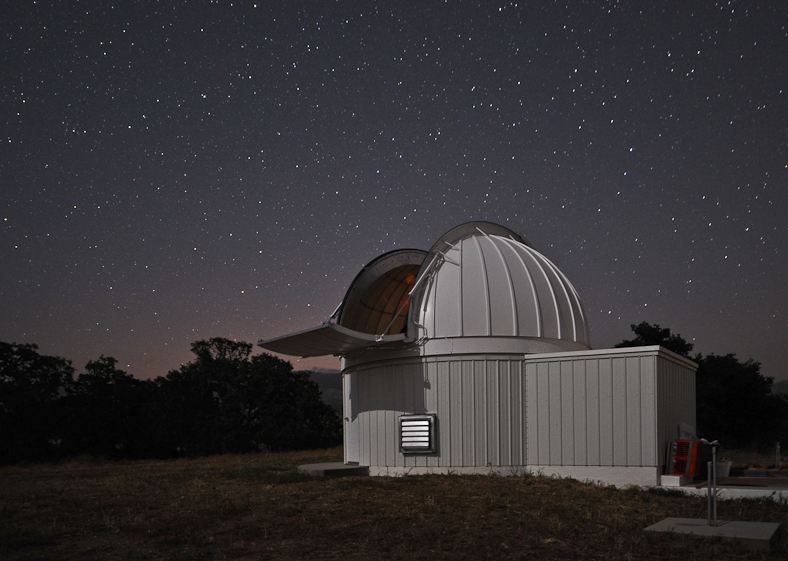
The Las Cumbres Observatory’s Outbursting Objects Key Project had monitored ATLAS near-daily and recorded a giant 0.9-mag outburst between November 2-4, and smaller ones on November 14 and 22. These brightening events coincided with the fragment activations seen in the Hubble images and thereby tied highresolution spatial information to more general photometric behaviors.
9. Scientific Value for Oort Cloud Studies
Because of the Oort Cloud’s 15 trillion km distance, its direct study is impossible. Every inbound comet represents a rare probe of its composition and structure. ATLAS is only the second bright Oort Cloud comet whose fragments Hubble has resolved, making it a critical datapoint for understanding how such bodies respond to the intense solar encounters after millions of years in deep freeze.
10. Imaging of Small Bodies in the Solar System
The ability of Hubble to follow fragment morphology over several days builds on earlier successes with comets such as 332P/Ikeya‑Murakami, where 25 icy blocks were tracked as they drifted apart. High‑resolution space‑based imaging can measure separation velocities, fragment sizes, and brightness changes, which offers an unmatched insight into breakup dynamics compared with what is possible from the ground with telescopes limited by atmospheric seeing.
The combined data set from Hubble and global ground networks has transformed ATLAS’s demise into a case study in the physics of cometary breakup-from the mechanics of hierarchical fragmentation through thermal delays in volatile release, this event shows how an Oort Cloud nucleus fails under solar stress and how its death can illuminate the hidden architecture of icy bodies at the edge of the Solar System.


