“When men can kill one another at six hundred yards they would generally prefer to do it at that distance.” That candid observation from a Union soldier drives home how precipitously firearms technology had advanced by the time of the American Civil War. The fighting became a proving ground for a dizzying assortment of long arms-from obsolete flintlocks pressed back into service to cutting-edge repeaters capable of firing a dozen rounds in less than a minute.
For a collector of antique arms, much like the historian of the Civil War, Union long arms symbolize much more than simple tools of combat but tangible links back to an age in American manufacturing and on the battlefield. Each model preserves a tale of invention, adaptation, and the logistical tests of arming hundreds of thousands of troops. This list explores ten of the most significant Union rifles and carbines by blending the technical detail with provenance and historical impact.
1. Springfield Model 1816 Flintlock Conversions
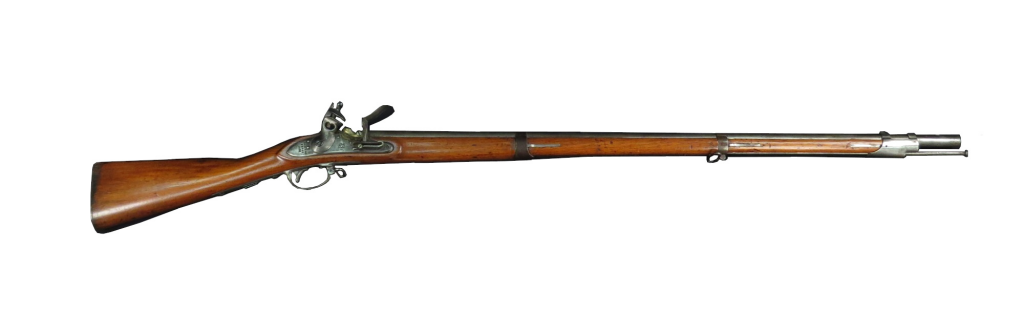
When the war started, the majority of the Union soldiers had guns that were already considered antique. Originally made at national armories and by contractors, the .69 caliber Model 1816 flintlock muskets were converted during the 1840s to percussion cap ignition. Smoothbores, these were muzzle-loaded and coupled with socket bayonets for close combat when circumstances proved possible. Outmoded as these were, they were put into service as needed along with other adapted arms such as the Model 1817 “Common Rifle” and the Model 1841 “Mississippi Rifle.” For surviving examples, their original conversion work and military cartouches have given collectors an interesting insight into the scramble of the Ordnance Department to arm its forces.
2. Springfield Model 1842 Percussion Musket
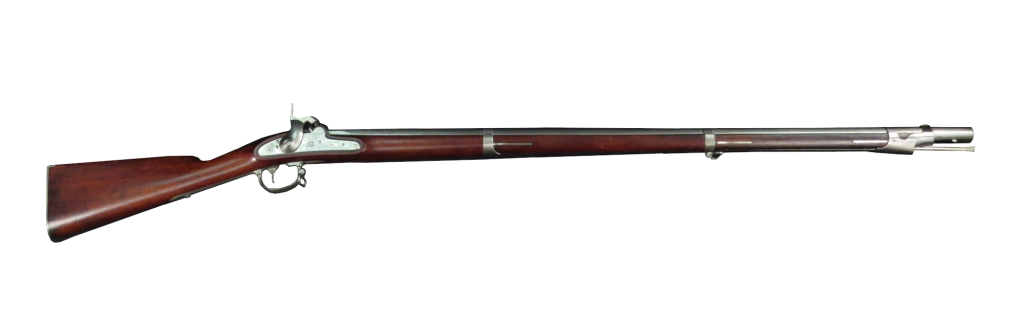
The .58 caliber Model 1842 was the first U.S. musket designed to be rifled after manufacture. Smoothbore when built, many were subsequently cut with rifling grooves to utilize the new Minié ball-a conical, hollow-based bullet that expanded upon firing into the rifling. This allowed faster loading, less fouling and greater accuracy. Thick-walled barrels on the Model 1842 made post-production rifling safe, creating the “rifled musket” that bridged old and new technology. Well-preserved Mexican American War dated examples such as those with bayonets selling at auction for more than $4,000 are prized for their transitional design.
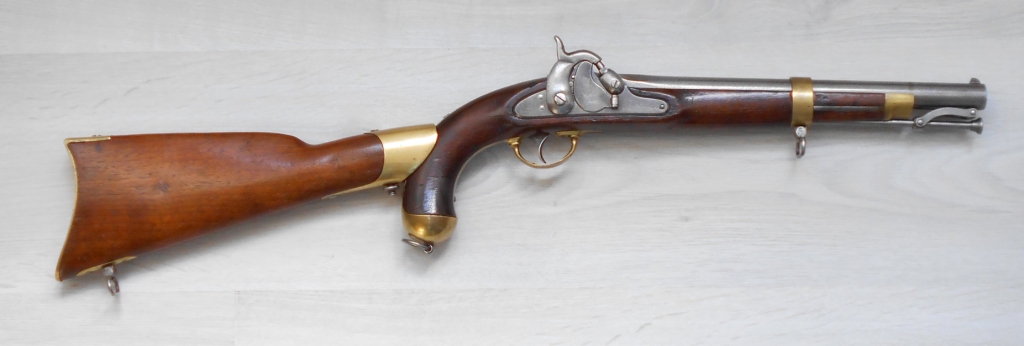
3. Springfield Model 1855 Rifle-Musket
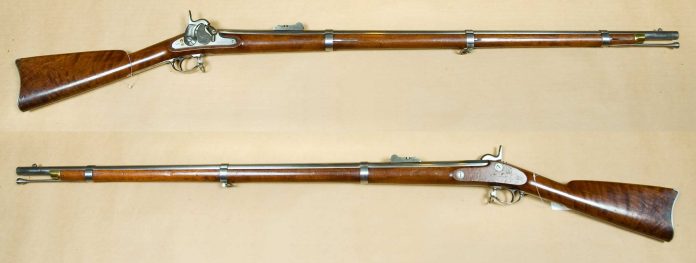
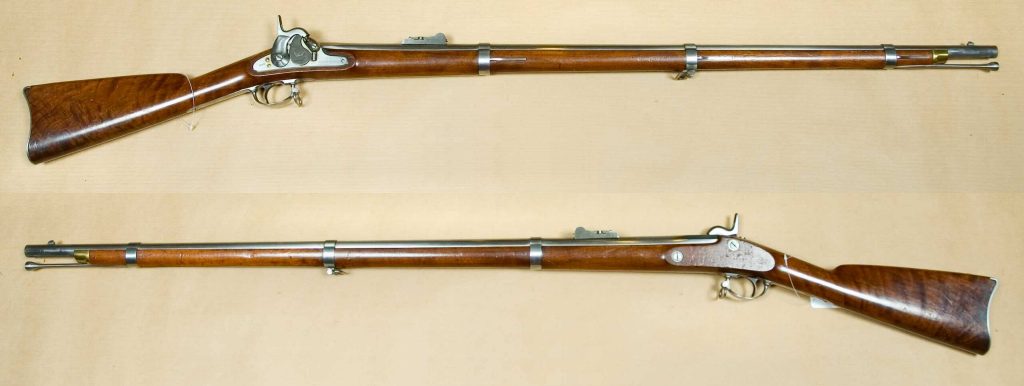
The Model 1855, introduced in .58 caliber and made at both Springfield and Harpers Ferry, featured Edward Maynard’s tape priming system. A roll of mercury fulminate caps was to advance automatically with each cocking of the hammer, theoretically hastening reloads. Unfortunately, the mechanism did not work in wet or combat conditions, and soldiers reverted to standard percussion caps. Distinctive “humped” hammers and teardrop primer doors mark these arms, which are attractive to collectors today for their mechanical curiosity and early use of integral priming.

4. Springfield Model 1861 and Variants
Essentially the Model 1855 without its unreliable tape primer, the Model 1861 became the standard Union rifle musket. Produced in great numbers-more than 265,000 at Springfield alone-it was succeeded by the Model 1863 and Model 1864. These muzzle-loaders fired the .58 caliber Minié ball with effective accuracy to 400 yards. Variations from different contractors, state contracts, and minor design changes make them fertile ground for collecting. Auction prices range from modest sums for service-worn examples to several thousand dollars for high-condition, early-dated pieces.
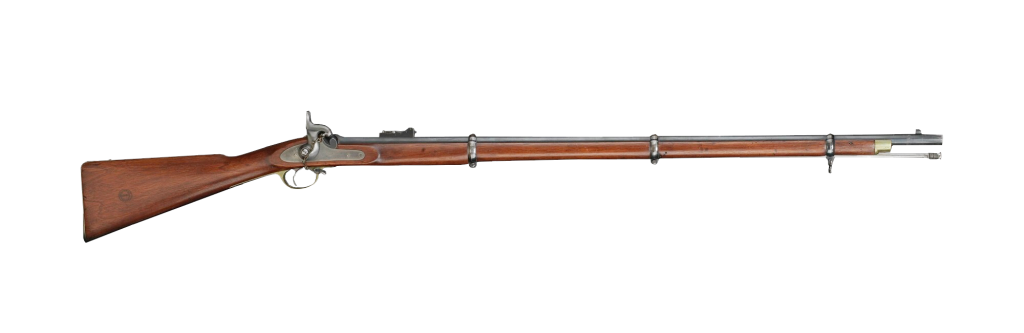
5. British Pattern 1853 Enfield
Britain’s standard infantry arm was the Pattern 1853 Enfield, imported in huge numbers by both sides. Chambered for the .577 caliber, with brass furniture and 17-inch socket bayonets, it had seen good service in the Crimean War. Union purchases made it the second most common rifle of the conflict. “Tower”-marked examples dated to the era of the Indian Rebellion, highly prized by collectors, may command premiums over later production on the basis of the scarcity and historical associations alone.
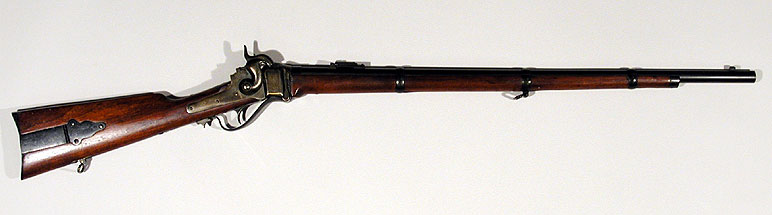
6. Sharps New Model 1859 and 1863
Christian Sharps’ breechloading falling-block rifles and carbines were renowned for their accuracy and rate of fire. The New Model 1859, in .52 caliber and using linen cartridges, was one of the models used by sharpshooter units such as Berdan’s. The New Model 1863 utilized a number of production shortcuts such as the elimination of patchboxes. Their use was extended into the Indian Wars by postwar metallic cartridge conversions. Confederate-made copies produced by S.C. Robinson add a very rare Southern dimension to Sharps collecting.
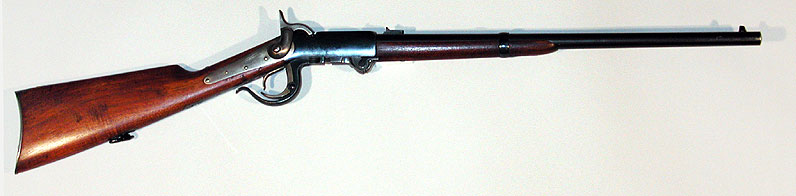
7. Burnside Fifth Model Carbine
This breechloader, of the design by Ambrose Burnside, used tapered brass cartridges with a central flash hole that was ignited by an external percussion cap. The lever under the breech tipped the breech block for extraction and loading, while the shape of the cartridge aided in reducing gas leakage. An extremely popular issue to Union cavalry, the Fifth Model of 1864 represented the pinnacle in the design. Carbines in surviving condition with intact case colors and wood finish, especially presentation-grade pieces, are highly sought after.
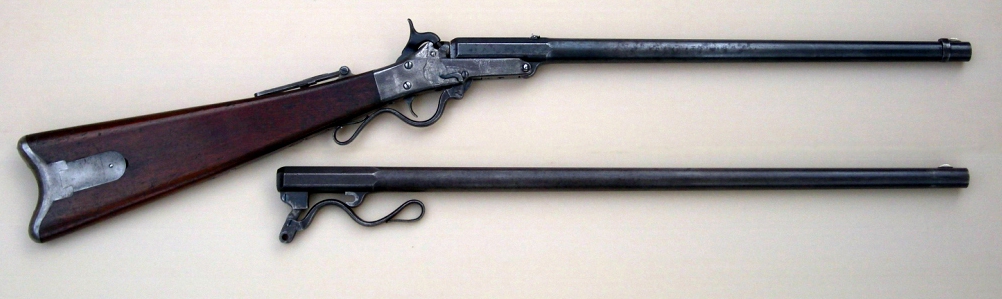
8. Maynard Second Model Carbine
Edward Maynard’s breechloader used reusable rimmed brass cases with no integral primers, relying instead for percussion ignition via a base hole. The Second Model was manufactured by Massachusetts Arms Co. and was of sufficiently robust construction as to be converted to fire self-contained metallic cartridges post-war. First Models were valued in Confederate militias for the easily reproduced cases; today, crisp inspector cartouches and original finish will greatly enhance auction values.

9. Spencer Repeating Rifle and Carbine
Christopher Spencer’s lever-action repeater chambered in the .56-52 or .56-50 rimfire fed from a seven-round tubular magazine in the buttstock. Capable of up to 20 rounds per minute, it was a battlefield force multiplier. Initially resisted by the Ordnance Department, it gained presidential approval after Abraham Lincoln tested one personally. The Blakeslee cartridge box, holding preloaded tubes, further hastened reloading. High-condition Spencers, particularly documented military pattern guns, can bring tens of thousands at auction.
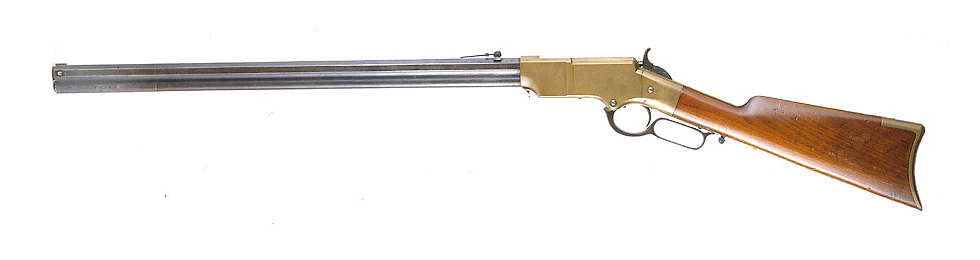
10. Henry Rifle
The .44 rimfire Henry, made by New Haven Arms Co., had a tubular magazine under the barrel holding fifteen rounds loaded from the front. It gave unprecedented sustained fire compared to muzzle-loaders. Only about 1,731 were purchased by the Union; many more were privately acquired by soldiers, particularly in the Western Theater. Early brass-frame Henrys without forearms are iconic and command premium prices for that reason alone, reflecting their rarity and revolutionary design.
From percussion-converted flintlocks to lever-action repeaters, Union long arms of the Civil War chart a rapid evolution in firearms technology. Each model represents to collectors and historians a blend of industrial ingenuity, battlefield adaptation, and logistical realities of a nation at war. Owning or studying these rifles and carbines is much more than owning hardware; it means the retention of stories about the soldiers who carried them and the pivotal role they played in shaping the outcome of America’s defining conflict.


